
Nepal is a landlocked, sovereign South Asian state situated in the Himalayas between China and India.
It is famous for its rich cultural heritage, deep spiritual significance as the birthplace of Lord Buddha, and unique blend of Hindu and Buddhist traditions. Nepal is generally safe for tourists, known for its welcoming culture and low violent crime rates. However, travelers should exercise caution due to potential political protests, demonstrations, and sporadic safety risks. Nepali people are widely regarded as exceptionally friendly, warm, and welcoming, often characterized by their polite and helpful nature toward visitors.
Studying in Nepal offers a high-value, affordable alternative with reputable programs in Medicine and Engineering, often costing significantly less than international options. pursuing an MBBS in Nepal is considered a very good option, especially for Indian students, offering high-quality education at an affordable cost (approx. INR 40–60 lakhs).
1. Official Name: Federal Democratic Republic of Nepal
2. Location: A landlocked country in South Asia, bordered by China (Tibet Autonomous Region) to the north and India to the south, east, and west.
3. Area: 147,516 km²
4. Capital: Kathmandu, which is also the nation’s largest city.
5. Currency: Nepalese Rupee (NPR).
6. Languages: Nepali is the official language. Other major mother tongues include Maithili, Bhojpuri, Tharu, and Tamang.
7. Economy: A developing economy primarily based on services (approx. 55%), agriculture (approx. 22%), and industry x(approx. 11%). It relies heavily on tourism, mountaineering, and remittances.
8. Total Population: Estimated at approximately 30,425,000 for 2026.
Nepal is a premier destination offering unparalleled Himalayan trekking , Here are the Top 10 reasons why Nepal is the best destination:
1. Himalayan Majesty & Mount Everest: Home to 8 of the 14 highest peaks in the world, including Mount Everest
2. World-Class Trekking & Adventure: Famous trails like Annapurna Circuit and Everest Base Camp offer adventure at all levels, plus paragliding, bungee jumping, and white-water rafting.
3. Rich Cultural Heritage & UNESCO Sites: Kathmandu Valley boasts seven UNESCO World Heritage Sites within a small radius, showcasing ancient temples, palaces, and stupas.
4. Birthplace of Lord Buddha (Lumbini): A sacred pilgrimage site where Buddha was born, attracting spiritual seekers and tourists to its serene monasteries and the Maya Devi temple.
5. Warm Hospitality (Atithi Devo Bhava): Nepalese people are renowned for being welcoming and kind, treating tourists as guests of honor, making it safe and comfortable for visitors.
6. Incredible Biodiversity & Wildlife: Jungle safari options in Chitwan National Park and Bardia National Park allow sightings of endangered one-horned rhinoceros, Bengal tigers, and crocodiles.
7. Unique Cultural Diversity: A harmonious blend of over 100 ethnic groups, offering a rich tapestry of festivals, traditions, music, and colorful customs.
8. Affordability and Value: Nepal is a budget-friendly destination, offering high-value experiences—including luxury trekking—at a lower cost compared to many other countries.
9. Spiritual & Yoga Retreats: A sanctuary for peace, offering meditation, yoga courses, and spiritual retreats in places like Pokhara and Kathmandu, blending Hinduism and Buddhism.
10. Diverse Landscapes: Offers incredible geographical variety, from high-altitude Himalayas to temperate hills and tropical Terai lowlands, all accessible within a small area.
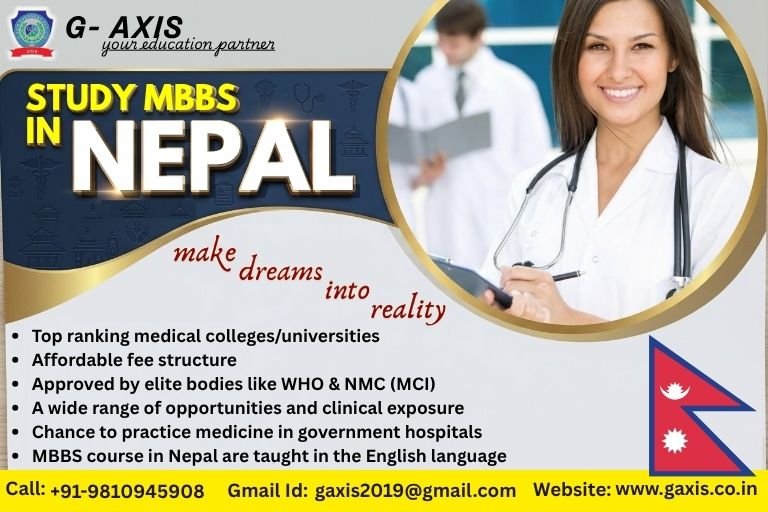
1. Affordability & Value: MBBS in Nepal offers a cost-effective alternative to private Indian colleges, with lower tuition and living expenses.
2. Accreditation: Colleges are recognized by the National Medical Commission (NMC) of India and the World Health Organization (WHO), enabling graduates to practice in India and globally.
3. Curriculum & Medium: The teaching medium is English, following a curriculum closely aligned with India’s, which prepares students well for the FMGE/NEXT licensing exam.
4. High Clinical Exposure: Many colleges are affiliated with private hospitals that provide ample hands-on patient interaction and training.
5. Location & Culture: Proximity to India allows for easy travel, and the cultural/linguistic similarity makes it comfortable for Indian students.
6. No Entrance Tests like IELTS: Unlike many Western countries, MBBS in Nepal generally does not require TOEFL or IELTS.
| Recognition | NMC and WHO approved Colleges |
| Eligibility | 50% in Physics, Chemistry and Biology Aggregate |
| Course Duration | 5 Years |
| Minimum Tuition Fee | ₹ 46,00,000 |
| Maximum Tuition Fee | ₹ 75,00,000 |
| NEET | Yes, compulsory |
| IELTS/TOFEL | Not Required |
| Medium of Teaching | English |
1. High-Quality & Recognized Education: Universities are recognized by the World Health Organization (WHO), FAIMER, and the National Medical Commission (NMC) of India.
2. Affordable Tuition and Low Cost of Living: MBBS fees in Nepal are significantly lower than private colleges in India and many other countries, offering excellent value for money.
3. No Donation Fees: Unlike some countries, most reputable medical colleges in Nepal do not require donations, keeping the process transparent.
4. Proximity & Cultural Similarity: For Indian students, the close proximity makes travel easy. The culture, language (Hindi is understood), and food are similar to India, reducing cultural shock.
5. English as the Medium of Instruction: All teaching, examinations, and clinical training are conducted in English, making it accessible to international students.
6. Excellent Clinical Exposure: Hospitals associated with medical colleges in Nepal are often well-equipped, providing significant hands-on, practical patient interaction.
7. High FMGE/NExT Success Rate: Due to a similar curriculum, students have a good success rate in exams like the FMGE (Foreign Medical Graduates Examination) and NExT.
8. Easy Entry Requirements: Admission usually requires 50% in PCB (Physics, Chemistry, Biology) and qualifying for the NEET exam (for Indian students), with no separate language exams like IELTS needed in many cases.
1. Academic Year Starts: September (Intake session).
2. Application Process: Starts early in the year, usually from April-May onwards.
3. Eligibility: 10+2 with Physics, Chemistry, Biology; 17+ years of age.
4. Entrance Exam: Applicants must pass the Medical Education Commission Entrance Examination (MECEE-BL).
5. NEET Mandatory: For Indian students, passing NEET-UG is mandatory to enroll and practice in India.
6. Process: The application process is generally straightforward with direct application to colleges or via the central counseling process, with high demand making early booking essential.
1. Age: Minimum 17 years of age on or before 31st December of the year of admission.
2. Academic Qualification: 10+2 (Higher Secondary) or equivalent exam with a science stream.
3. Subject Requirements: Physics, Chemistry, and Biology (PCB) are mandatory subjects.
4. Minimum Marks: At least 50% aggregate in PCB in 10+2 or equivalent examinations.
5. NEET Requirement: A valid NEET-UG score is mandatory for Indian students to gain admission and to ensure the degree is recognized by the National Medical Commission (NMC).
6. Entrance Exam (MECEE): Applicants must appear for and qualify
Essential Documents
1. 10th and 12th Standard Mark Sheets
2. NEET-UG Score Card
3. Birth Certificate / Valid Passport
4. Transfer/Character Certificate from the previous school
5. Passport Size Photographs
| So.No. | Name |
|---|---|
| 1. | B.P. Koirala Institute of Health Sciences (BPKIHS), Dharan |
| 2. | Institute of Medicine (IOM), Kathmandu |
| 3. | Kathmandu Medical College (KMC), Kathmandu |
| 4. | Manipal College of Medical Sciences (MCOMS), Pokhara |
| 5. | College of Medical Sciences (COMS), Bharatpur |
| 6. | Nepal Medical College (NMC), Kathmandu |
| 7. | Nobel Medical College, Biratnagar |
| 8. | Universal College of Medical Sciences (UCMS), Bhairahawa |
| 9. | Chitwan Medical College (CMC), Chitwan |
| 10. | Lumbini Medical College (LMC), Palpa |
| 11. | Nepal Army Institute of Health Sciences (NAIHS), Kathmandu |
| 12. | Patan Academy of Health Sciences (PAHS), Lalitpur |
The MBBS course in Nepal is a 5.5-year program (4.5 years of academic study + 1-year mandatory internship) and is structured into three main phases.
| So.No. | Key Details |
|---|---|
| 1. | Phase 1: Pre-Clinical Phase (Years 1–2): Focuses on foundational subjects like Anatomy, Physiology, Biochemistry, Community Medicine, and introductory clinical exposure. |
| 2. | Phase 2: Para-Clinical Phase (Year 3): Covers subjects bridging basic science and clinical medicine, such as Pathology, Microbiology, Pharmacology, Forensic Medicine, and Community Medicine. |
| 3. | Phase 3: Clinical Phase (Years 4–5): Focused on core clinical subjects, including Medicine, Surgery, Pediatrics, Gynecology & Obstetrics, Orthopedics, and Radiology. |
| 4. | Final Year: Internship (1 Year): A mandatory rotational internship providing hands-on practical training in various clinical departments. |
1. Select Colleges: Identify NMC-recognized medical colleges in Nepal.
2. Submit Application: Apply via the University/College portal with required documents.
3. Entrance/Direct Admission: Qualify in the MECEE-BL exam or secure a seat based on NEET scores.
4. Visa/Documentation: Secure a student visa using the invitation letter.
5. Final Selection: Complete the document verification and pay fees.
1. SAARC Scholarship Scheme: Offers financial aid to students from SAARC countries, providing seats in government-affiliated medical colleges.
2. Nepal Aid Fund Scholarship Scheme: Dedicated funding for Indian and Nepali students based on academic performance and need.
3. Mahatma Gandhi Scholarship Scheme: Specifically targeted at academically excellent Indian students pursuing higher studies in Nepal.
4. B.P. Koirala Institute of Health Sciences (BPKIHS) Scholarships: Autonomous institution offering merit-based scholarships for the MBBS program.
5. Tribhuvan University (Institute of Medicine – IOM) Scholarships: Limited merit-based seats available for high-ranking students in the Common Entrance Exam (CEE).
6. Kathmandu University Scholarship Seats: Scholarships provided for deserving students in affiliated colleges, including foreign national seats.
7. Manipal College of Medical Sciences (MCOMS) Merit Scholarships: Provided to top-performing students in the 5.5-year MBBS program.
8. NGO/Private Scholarships: Various charitable organizations and NGOs offer limited, need-based scholarships for medical studies in Nepal.
9. Zolve Global Scholarship: Provides need-based assistance to international students studying abroad, applicable for medical education in Nepal.
10. Institutional Merit Scholarships: Several private colleges offer fee waivers for international students who show exceptional performance in the first year.
1. Postgraduate Studies (MD/MS/MDMS): Graduates can pursue PG specialization in clinical (Medicine, Surgery, Gynae) or non-clinical subjects (Anatomy, Pharmacology) in Nepal or abroad.
2. Practice in India (FMGE/NEXT): Since many Nepalese colleges are NMC-approved, graduates can return to India to appear for the Foreign Medical Graduate Examination (FMGE) / NEXT to register and practice medicine.
3. Work as a General Practitioner in Nepal: Graduates can register with the Nepal Medical Council (NMC) to work as Medical Officers in government or private hospitals, clinics, or nursing homes.
4. Global Opportunities (USMLE, PLAB, AMC): The degree is globally recognized (WHO listed), enabling doctors to take licensure exams for countries like the USA (USMLE), UK (PLAB), and Australia (AMC).
5. Healthcare Management and Administration (MBA/MHA): Doctors can specialize in hospital management, public health, or health informatics to work in administrative roles in the healthcare sector.
6. Medical Research and Academia: Graduates can work as lecturers in medical colleges or as clinical researchers and research associates.
| So.No. | Key Details | |
| 1. | Medical Officer (Government): Serving in PHCs, district hospitals, or central hospitals. | |
| 2. | Medical Officer (Private Hospital/Clinic): Emergency/Casualty departments. | |
| 3. | General Practitioner (Primary Care Physician): Working in clinics or private practice. | |
| 4. | Medical Intern: Mandatory 1-year internship (post-MBBS). | |
| 5. | Emergency Room Doctor (Duty Officer): Managing accident victims and trauma cases. | |
| 6. | Medical Educator (Tutor/Lecturer): Teaching in medical colleges (non-clinical departments). | |
| 7. | Resident Doctor (MD/MS): Pursuing clinical specialization in Nepal. | |
| 8. | Hospital Administrator: Managing hospital operations. | |
| 9. | Public Health Officer/Consultant: Working with NGOs/INGOs on community health. | |
| 10. | Medical Researcher: Conducting clinical research and drug trials. | |
| 11. | Armed Forces Doctor: Serving in the Nepal Army Medical Corps. | |
| 12. | Medical Transcriptionist: Specializing in healthcare documentation. | |
| 13. | Industrial Medical Officer: Doctor for factories/large corporate firms. | |
| 14. | Medical Content Writer/Educator: Creating medical educational content. | |
| 15. | Clinical Research Coordinator (CRC): Managing clinical trials. | |
| 16. | Pharmacy Consultant: Providing expert advice on medicine usage. | |
| 17. | Pharmaceutical/Medical Advisor: Working in drug safety and marketing. | |
| 18. | Health Policy Analyst: Developing healthcare protocols for organizations. |
Starting salaries for MBBS graduates (Medical Officers) in Nepal are generally modest, ranging from NPR 35,000 to NPR 55,000 per month.
Key Salary Information for Doctors in Nepal:
1. Internship (Intern Doctor): Roughly NPR 10,000 to NPR 15,000 per month.
2. Medical Officer (Entry Level): Government Hospital: ~NPR 45,000 – NPR 55,000+ per month, Private Hospital: Varies widely, often lower than government initially.
3. Specialist/Consultant: NPR 1,50,000 to over NPR 4,00,000 per month, particularly in private practice.
4. Post-MBBS Abroad: Many graduates opt for specialization in the US or UK, where residency provides a significantly higher immediate income, offering faster, high-income potential.
Contact us for more information
can help – fill in your details and we’ll call you back.

Chat Now