Serbia, officially the Republic of Serbia, is a landlocked country in the central Balkans of Southeast Europe. With its capital in Belgrade, this sovereign republic (since 2006) has a population of roughly 6.6–6.7 million, a rich history, and acts as a cultural bridge between East and West. Serbia is a country in Southeastern Europe, located in the heart of the Balkans, renowned for its rich history, vibrant culture, and stunning natural landscapes.
Serbia is increasingly considered a very good destination for working and settling, particularly for foreign professionals, digital nomads, and expats looking for an affordable European lifestyle. It is rapidly becoming a popular relocation hub due to its low cost of living, booming IT sector, and straightforward immigration processes.
1. Official Name: Republic of Serbia
2. Location: A landlocked country in Southeastern Europe, situated at the crossroads of the Balkan Peninsula and the Pannonian Plain. It shares borders with Hungary, Romania, Bulgaria, North Macedonia, Montenegro, Bosnia and Herzegovina, and Croatia.
3. Area: The total area is approximately 88,499 square kilometers (34,170 sq mi)
4. Capital: Belgrade (Beograd), which is also the country’s largest city.
5. Currency: Serbian Dinar (RSD)
6. Languages: Serbian is the official language
7. Economy: An upper-middle-income economy predominantly based on the service sector, which accounts for roughly two-thirds of the GDP. Major industries include energy, automotive, machinery, and mining. Serbia is also a significant global exporter of raspberries and fruit.
8. Total Population: Estimated at approximately 8.41 million
Permanent residency in Serbia is generally available to foreign citizens after three years of continuous, approved temporary residency. Applicants must be physically present in Serbia for at least 26 months during those three years, or adhere to specific, shorter absence rules. This status allows indefinite stay, work, and a pathway to citizenship.
1. Time Requirement: Three years of uninterrupted temporary residence. Continuous residence allows for total absences of up to 10 months or a single absence of up to 6 months during that period.
2. Residential Address: Evidence of owning or renting property is required.
3. Proof of Subsistence: Documentation showing sufficient financial funds for living expenses.
4. Valid Passport: Must be valid for the duration of the permit.
5. Health Insurance: Proof of valid health insurance.
1. Valid Foreign Passport: Original and copies of the first page.
2. Proof of Residential Address (White Card): Registration of your place of residence in Serbia.
3. Proof of Sufficient Funds: Documentation demonstrating you have the financial means to support yourself (e.g., bank statements).
4. Health Insurance: Proof of health insurance coverage.
5. Justification Documents: Proof of eligibility, which may include:
6. Marriage certificate (if based on marriage to a Serbian citizen).
7. Documents proving three years of continuous temporary residence.
8. Documentation for special cases (e.g., people of Serbian origin).
9. Photographs: Two color photos (3.5 x 4.5 cm).
10. Proof of Paid Administrative Fees: Receipt for state duty payments.
Serbian citizenship is primarily obtained through descent, birth, or naturalization after three years of temporary residence and subsequent permanent residency. The process requires legal residence, a 3-year marriage to a citizen, or significant investment/merit. Applicants must show no criminal record and sign a statement that they consider Serbia their state.
Key Pathways to Serbian Citizenship
1. Naturalization (Standard): Typically requires 3 years of temporary residence, followed by permanent residence, although “26 months of physical presence” within three years is the core requirement.
2. Marriage: Foreigners married to a Serbian citizen for at least 3 years can apply, provided they hold a permanent residence permit.
3. Descent: Individuals with Serbian descent have the right to acquire citizenship by written request.
4. Investment/Merit (Fast-Track): Citizenship can be granted by exception (Article 19) for exceptional contributions, such as significant investments, technology leadership, or high-level sports contributions, bypassing standard residency requirements. Donations of €250,000+ are generally considered for this route.
5. Residence through Investment: Investing in real estate or founding a company allows foreigners to secure a residence permit, acting as a pathway to legal residency.
1. Low Cost of Living & High Quality of Life: Serbia offers an affordable, European lifestyle, with lower expenses compared to Western Europe, while maintaining a high quality of life.
2. Low Taxes and Financial Freedom: Serbia offers moderate taxation, with personal income tax around 10% and corporate tax around 15%, alongside no automatic CRS (Common Reporting Standard) bank reporting for citizens, allowing for high financial privacy.
3. Easy Residency Options: Residency is easily obtained through setting up a company or purchasing real estate, making it accessible for entrepreneurs and investors.
4. Strategic Location and Connectivity: Located in the heart of Europe, Serbia acts as a bridge between East and West, with excellent flight connectivity to Europe, the U.S., and Asia.
5. Rapid Economic Development: Foreign investment is booming, particularly in IT, technology, and infrastructure, offering numerous business and employment opportunities.
6. Safety and Security: Serbia is considered a safe country with low rates of violent crime and high stability.
7. Welcoming Culture and English Proficiency: Serbians are known for being hospitable, and English is widely spoken in major cities like Belgrade, easing the transition for foreigners.
8. Thriving Tech and Crypto Sector: With a booming IT sector, the government offers incentives for startups, and it has a favorable environment for cryptocurrency, with a 15% tax on gains.
9. Fast Track to Citizenship: Compared to many EU countries, Serbia offers a relatively straightforward path to permanent residency and, in some cases, citizenship for investors.
10. A “Safe Haven” Alternative to the EU: As a country outside the EU, Serbia offers freedom from excessive EU regulations, high taxes, and social issues, providing a unique alternative for those seeking more personal freedom.
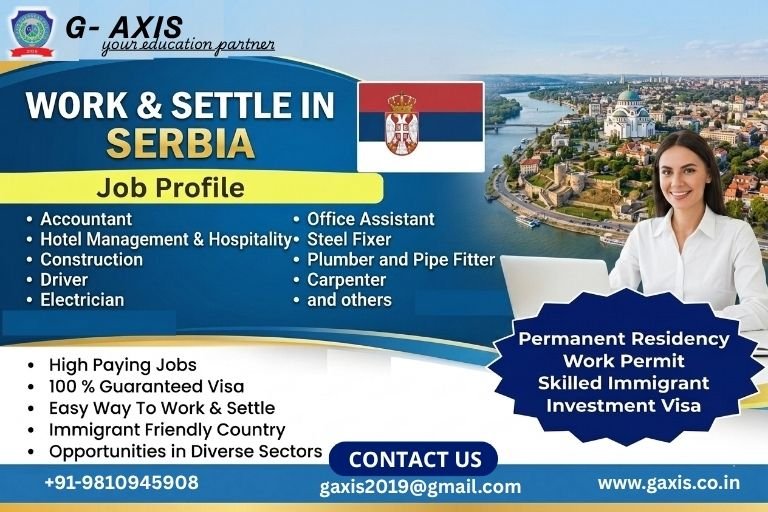
Working in Serbia as an international worker requires a job offer, followed by a combined single residence/work permit application. Serbia offers high demand for workers in construction, IT, logistics, and hospitality. The process is streamlined, and applicants typically need a valid passport, employment contract, and to meet company qualifications.
1. Frontend/Backend Software Engineer
2. Data Visualisation Software Engineer
3. Full Stack Developer
4. Product Owner
5. IT Support Specialist
6. Telecom Rigger (High Altitude Work)
7. Site Foreman/Supervisor (Highway/Bridge Construction)
8. Electrical Engineer / Supervisor
9. Welder (Construction & Metal Industry)
10. Plasterer (Construction)
11. Tiler (Construction)
12. Construction Worker (General)
13. Production Operator (Puratos Schobbers)
14. Forklift Driver / Materials Handler
15. Lab Technician
16. Client Manager/Success Representative (Remote, 360Dialog)
17. Digital Merchandiser/Content Assistant (eStoreLabs)
18. Recruiter (Remote, ACM Limited)
19. Senior Accountant (HeadQuarters)
20. Games Presenter
1. Average Earnings: In 2025, urban centers like Belgrade and Novi Sad offer higher monthly salaries, often between 85,000 and 100,000 RSD, while rural areas typically range from 65,000 to 75,000 RSD,
2. Highest Paid Cities: Belgrade has the highest average annual salary (~$28,976 USD), followed by Subotica (~$27,861 USD),
3. Minimum Wage: The minimum wage for 2025 was set to increase by 13.7%, providing a base of roughly 53,000+ RSD.
1. Communication Style: Serbs are direct, yet polite, communicators. They appreciate transparency, and while they might be informal in conversation, respect for hierarchy is crucial.
2. Time and Pace: While the “polako” culture (relaxed pace) exists, modern business expects punctuality. Deadlines are important, though sometimes approached with flexibility.
3. Workplace Environment: The standard workweek is 40 hours, from roughly 9 am to 5 pm or 8 am to 4 pm. Employees typically receive 20+ days of paid annual leave, and coffee culture is heavily integrated into the work day.
4. Etiquette: Business cards are frequently exchanged. It is polite to bring small gifts (e.g., wine, chocolates) to professional meetings.
5. Decision Making & Risk: Changes can be slow and require significant planning due to a cautious approach towards risks, often influenced by potential negative outcomes of failure.
1. Employment Contracts: Must be in writing (hand-signed) and include salary, working hours, and job description. Contracts are generally for an indefinite period, with fixed-term allowed under specific conditions.
2. Working Hours: The standard workweek is 40 hours. Overtime is permitted but strictly regulated.
3. Rest Periods: Employees are entitled to a daily rest of at least 12 consecutive hours and a weekly rest of at least 24 hours.
4. Annual Leave & Sick Leave: A minimum of 20 working days of paid annual leave is guaranteed.
5. Minimum Wage: Fixed by the Socio-Economic Council or the Government.
6. Maternity/Parental Leave: Mothers are entitled to up to 3 months of maternity leave, with total maternity and childcare leave lasting up to 365 days.
7. Termination: Employers must follow strictly defined legal procedures to terminate an employee, often requiring justified reasons (e.g., performance, misconduct).
8. Notice Periods: Range from 15 to 30 days after probation, with 30 days standard for resignation.
9. Safety & Health: The 2023 Law on Safety and Health at Work aligns with EU standards, including regulations for remote work.
A Serbian work visa (Visa D) allows foreign nationals to legally live and work in Serbia, typically requiring a confirmed job offer and employer sponsorship to initiate the process. The process involves obtaining a work permit followed by a long-stay visa and temporary residence permit, which can take 1.5 to 3 months, offering stays of up to 180 days to one year, renewable.
A Serbian work visa (Visa D) allows foreign nationals to legally live and work in Serbia, typically requiring a confirmed job
1. Job Offer: A signed contract with a Serbian employer is required.
2. Work Permit: The employer applies for this at the Serbian Employment Agency.
3. Visa D Application: Apply at the local Serbian embassy. Required documents often include a passport (valid at least 90 days after departure), photos, invitation letter/contract, and proof of health insurance.
4. Residence Permit: Upon arrival, you must apply for a temporary residence permit (usually valid for up to 3 years) while your visa is valid.
5. Processing Time: Generally takes 1.5 to 3 months for the full process.
Serbia offers a relaxed, social, and affordable European lifestyle, blending traditional Balkan hospitality with vibrant, modern city life in Belgrade and Novi Sad. The cost of living is lower than Western Europe, featuring4seasons, rich café culture, and intense nightlife, alongside a strong emphasis on family, nature, and, for many, a preference for, or openness to, a more traditional family structure.
We provide all types of jobs based on your qualification and skill. Contact us for more information and VISA apply
can help – fill in your details and we’ll call you back.


Chat Now