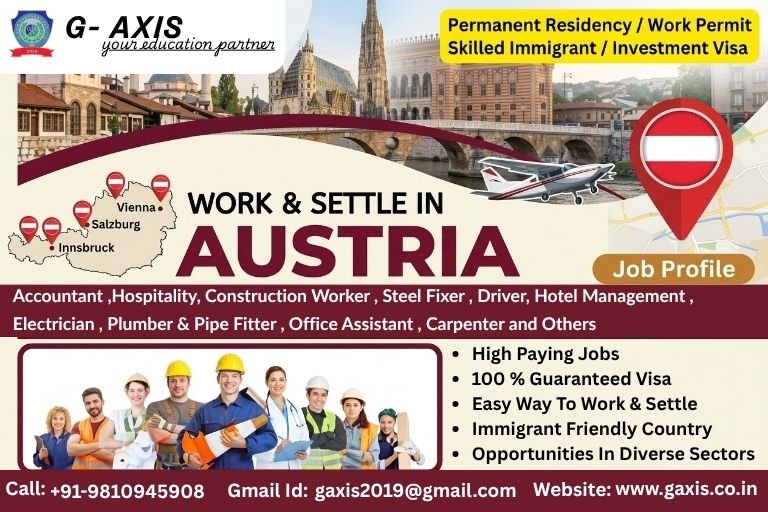
Austria is a landlocked country in Central Europe known for its Alpine landscapes, rich cultural history, and high quality of life. As a federal parliamentary republic, it consists of nine states, with Vienna as its capital and largest city. A member of the European Union, Austria is famous for its music, art, and scenic beauty. Austria is considered an exceptionally safe country, consistently ranking among the top 5-10 most peaceful nations globally. It features very low crime rates, high political stability, and strong social cohesion, making it secure for both residents and tourists. Major cities like Vienna are noted for being very safe.
Austria is an excellent country for working and settling, offering a high standard of living, strong social security, and a 4% job vacancy rate in sectors like IT, engineering, and healthcare
Austria is world-renowned for its breathtaking Alpine landscapes, rich classical music heritage, and imperial history centered in Vienna. As the birthplace of Mozart and a hub for artists like Beethoven, it is known for grand architecture, coffee house culture, winter sports, and culinary staples.
1. Official name: Republic of Austria
2. Location: A landlocked country in Central Europe, situated in the Eastern Alps. It shares borders with eight countries: Germany, Czech Republic, Slovakia, Hungary, Slovenia, Italy, Switzerland, and Liechtenstein.
3. Area: Approximately 83,879 km² (32,386 sq mi).
4. Capital: Vienna (Wien), which is also the country’s most populous city and its own federal state.
5. Currency: Euro (€).
6. Languages: German is the official language
7. Economy: A highly developed, high-income social market economy with a strong emphasis on industry, tourism, banking, and renewable energy. Austria is a member of the European Union and the OECD.
8. Total Population: Estimated at approximately 9.26 million (2026 estimate).
Permanent Residency in Austria is an unlimited residence permit for non-EU/EEA nationals who have lived in the country for at least 5 years, offering unrestricted access to the labor market, equal status to citizens in many areas, and, generally, the right to free movement for up to 12 months outside the EEA.
| Visa Type | Permanent Residence Permit |
| Time Frame | 3-12 months |
| Requirements | Proof of funds to finance daily life without working income; health insurance; accommodation in Austria; clean criminal record |
| Minimum Investment | None |
| Taxation | No wealth, net worth, gift or IHT tax; flat rate income tax of 25% on most interest payments received from banks, on dividend received from shares and on most capital gains; other income subject to max. tax rate of 50% |
| Years to qualify for Citizenship | 6-10 years residence |
| Language for Citizenship | Yes |
| Permanent Residence | n/a |
| Other requirements | None |
| Dual Citizenship | Restricted – possible under certain circumstances |
1. Time Requirement: At least 5 years of uninterrupted residence in Austria with a valid title (e.g., RWR Card, Red-White-Red Card Plus, or EU Blue Card).
2. Financial Stability: Proof of regular, fixed income that covers living expenses without utilizing social welfare (approx. €1,308.93/month for singles, €2,064.12 for couples as of 2026).
3. Language Skills: Proof of German language proficiency, typically at A2 or B1 level, along with completion of Module 2 of the Integration Agreement.
4. Accommodation: Evidence of adequate, locally customary housing, such as a rental contract.
5. Health Insurance: Comprehensive health insurance that covers all risks within Austria.
6. Clean Record: A criminal record check, demonstrating no significant criminal history
Application Process
1. Submit Application: Apply in person at the local provincial government authority or authorized immigration office in Austria.
2. Documentation: Provide a valid passport, photos, proof of 5-year residency, income evidence, housing proof, and language certificates.
3. Processing Fee: The processing fee is approximately €210.
4. Processing Time: Usually takes a few months.
Renewing a permanent residence permit (Daueraufenthalt-EU) in Austria is required every five years to update personal data. You must submit the application to your local residency authority (e.g., MA 35 in Vienna, Bezirksmannschaft) before the current card expires, ideally up to three months in advance.
Working in Austria offers a high standard of living, strong social security, and a 40-hour work week, with high demand for skilled professionals in IT, engineering, healthcare, and tourism.
Here is a detailed breakdown of working in Austria:
1. Working Hours: Standard full-time work is generally 40 hours per week, often with 5 weeks of paid vacation.
2. Salary: Salaries are generally high, with a mandatory 13th and 14th-month salary (vacation and Christmas pay).
3. Work Culture: Often described as “work to live,” emphasizing a balance, though professional and direct.
4. Language: While English is used in international companies, speaking German is crucial for most positions and daily life.
IT & Technology (High Demand)
1. Software Engineers/Developers (Java, Python, AI)
2. Data Scientists/Analysts
3. Cybersecurity Specialists
4. Cloud Architects/DevOps Engineers
5. Systems Analysts
6. SAP Consultants
Engineering (Manufacturing & Renewable Energy)
1. Mechanical Engineers (Automation, CAD)
2. Electrical/Power Engineers
3. Civil Engineers/Construction Managers
4. Mechatronics Technicians
5. Technical Sales Engineers
Healthcare & Life Sciences (Aging Population Demand)
1. Registered Nurses
2. General Practitioners/Doctors
3. Medical Technicians
4. Pharmacists/Biotech Researchers
Business, Finance & Logistics
1. Financial Analysts/Auditors
2. Accountants/Payroll Accountants
3. Key Account Managers/Sales Managers
4. Logistics/Supply Chain Managers
5. HR & Talent Acquisition Specialists
1. Healthcare: High demand for nurses, geriatric nurses, nursing assistants, and therapists.
2. Information Technology (IT): Shortages in software developers, data analysts, cybersecurity specialists, and systems technicians.
3. Engineering & Technical Roles: Core engineering (mechanical, civil), electrical engineers, and high-voltage specialists (Starkstrom).
4. Skilled Trades: Carpenters, masons, metalworkers, and machine technicians.
5. Other Critical Areas: Locomotive drivers, payroll specialists, and inclusive early-childhood educators.
Work visas in Austria for non-EU/EEA citizens are primarily managed through the Red-White-Red (RWR) Card, a points-based system for skilled workers, shortages occupations, or graduates. The RWR Card allows you to live and work for a specific employer for 24 months. Other options include the EU Blue Card for highly qualified professionals and a 6-month Job Seeker Visa.
1. Red-White-Red Card: For qualified workers, offering a 24-month residence and work permit tied to an employer.
2. Red-White-Red Card Plus: A subsequent permit allowing for unrestricted labor market access.
3. EU Blue Card: For high-skilled,,,, non-EU/EEA professionals.
4. Job Seeker Visa: A 6-month visa for highly qualified individuals to find work.
Salaries in Austria are generally good, with a high standard of living and a median gross annual income of approximately €45,600–€56,000 for full-time employees. A key advantage is that employees receive 14 salaries per year, including bonuses for holidays and Christmas. However, the cost of living is high, particularly in Vienna.
Key details about salaries and work in Austria:
1. Average Earnings: The gross average salary is around €3,800 per month (€45,600–€56,000 annually).
2. 14 Salaries: Employees receive 12 monthly payments plus, 13th and 14th salaries, which are taxed at a lower rate.
3. High-Demand Sectors: IT, engineering, healthcare, and construction offer some of the highest salaries.
4. Cost of Living: While salaries are high, expenses such as housing in Vienna (often €1,000–€1,200+ for rent) can be significant.
5. Weekly Hours: Full-time is typically 40 hours per week.
The lifestyle in Austria is widely regarded as one of the best in the world, consistently ranking at the top for quality of life, safety, and environmental standards. It is characterized by a “calm” atmosphere, a strong emphasis on work-life balance, and a deep, ingrained connection to nature, particularly through activities like hiking and skiing.
can help – fill in your details and we’ll call you back.
Chat Now