Slovenia is a small, safe, and stunningly green country in Central Europe, located between Italy, Austria, Hungary, and Croatia. Slovenia is world-renowned for its pristine, eco-friendly nature, featuring the iconic Lake Bled, the Julian Alps, and Triglav National Park. As a premier, sustainable, and outdoorsy destination, it is famous for hiking, skiing, cycling, and the breathtaking Postojna Cave. It is also known for its rich beekeeping tradition, Lipizzaner horses, and the charming capital, Ljubljana.
Slovenia is a great place to settle, offering high living standards, beautiful landscapes, and proximity to countries like Switzerland, Croatia, and the Balkans. The country is safe, with good healthcare and education.
1. Official name: Republic of Slovenia
2. Location: Central Europe, bordered by Italy to the west, Austria to the north, Hungary to the northeast, and Croatia to the south and southeast.
3. Area: Approximately 20,273 square kilometres (7,827 sq mi).
4. Capital: Ljubljana.
5. Currency: Euro (€) (since 2007).
6. Languages: Slovenian (Slovene) is the official language. Italian and Hungarian are co-official in ethnically mixed regions.
7. Economy: A developed, high-income economy that is small, open, and export-oriented. Key sectors include manufacturing (automobiles, chemicals, and electronics), services, and tourism.
8. Total population: Approximately 2.11 million people (2026 estimate).
| Temporary residence permit types | – employment, – business, – study, – family reunification, etc. |
Time needed to obtain the temporary residence permit (approx.) | up to three months |
Temporary residence permit validity | 1 year |
| Documents for obtaining temporary residence | – recent photo, – evidence attesting the purpose of stay, – travel document, – health insurance, – evidence on having sufficient financial funds, – proof of address in Slovenia, – other papers that can vary based on the purpose of arrival |
| Mandatory registrations with state authorities (i.e. with the population/municipality register) | With the competent administrative unit in the region where the foreigner has his/ her residence |
| Dependents can join the temporary permit holder | No (it can happen only when the temporary permit is renewed) |
| Temporary or permanent residency for investment purposes | Yes |
| Minimum temporary residence before applying for permanent residence | 5 years |
| Documents for obtaining permanent residence | – identity documents, – proof on the permanent address and on the right to use the respective address (property documents, tenancy agreements) |
| Naturalization requirements | – permanent residency for 5 years and proof of living in Slovenia for 10 years; – tax obligations in Slovenia, – Slovenian language skills |
| Citizenship after permanent residence | It can be obtained in 5 years after becoming a permanent resident, but there are simpler rules for certain categories of individuals. |
Slovenia offers a high quality of life and a pathway to EU permanent residency (after 5 years) for those who live, work, or study there legally. Non-EU nationals need a visa to enter, followed by a temporary residence permit (renewable annually) for employment, study, or business, which can lead to permanent status.
Slovenia primarily offers two main types of residence permits:
1. Temporary (fixed-term, usually for 1 year)
2. Permanent (indefinite, typically after 2–5 years of legal residence)
These are issued based on specific purposes like employment, business, or family reunification
| Temporary | Permanent | |
| Duration: | 1-3 years | 10 years |
| Conditions: | You need to have a reason behind your stay. This can be either a work permit or a student visa. | You must have lived in Slovenia with a temporary residence permit for 5 consecutive years. |
| Benefits: | You can work and study in Slovenia until your temporary residence permit expires. | You receive the same benefits as a Slovenian citizen under a permanent residence permit. |
1. Five-Year Continuous Stay: Most applicants, including third-country nationals (non-EU), must live in Slovenia for five years on a temporary basis.
2. EU Blue Card: If you have an EU Blue Card, you can apply after five years of legal residence in the EU, provided at least the last two years were in Slovenia.
3. Family Reunification: Family members of Slovenian citizens or permanent residents may qualify for expedited processes.
4. Business Basis: Individuals who establish a company, invest €50,000, and show active business operations can obtain temporary residency, eventually leading to permanent residency.
1. Application Form: Completed form No. 28/1 (available at administrative units or embassies).
2. Valid Passport: Original and a photocopy of the identification page.
3. Biometric Photo: Recent photograph suitable for identification documents.
4. Proof of Continuous Residence: Evidence of 5 years of legal, continuous, and uninterrupted residence in Slovenia (e.g., previous residence permits).
5. Proof of Sufficient Funds: Bank statements, salary slips, or other evidence showing you can support yourself.
6. Valid Health Insurance: Proof of insurance covering medical services in Slovenia.
7. Criminal Record Certificate: A clean criminal record certificate from your home country, generally not older than 3 months, with an apostille and translated into Slovenian.
8. Proof of Registered Address: Documentation confirming your registered residence address in Slovenia.
You can typically apply for Slovenian citizenship after a total of 10 years of legal residence in Slovenia. This usually consists of 5 years of temporary residence followed by 5 years of permanent residency. The final 5 years must be continuous, and you must meet language, financial, and good character requirements.
Obtaining residence in Slovenia through business investment generally requires establishing a company with a minimum €7,500 share capital, followed by a €50,000 investment in the business (e.g., equipment, real estate) within six months, or employing a local citizen. The process typically takes 4–6 months to secure a 12–24 month temporary residence permit.
1. Company Formation: Register a limited liability company (d.o.o.), which requires a minimum of €7,500 in share capital.
2. Investment Threshold: Invest at least €50,000 into the business within the first six months of registration. This can include purchasing tangible assets like machinery, equipment, or real estate necessary for business activities.
3. Active Business Operation: The Company must be actively operating, which can be demonstrated by generating at least €10,000 in revenue per month over six consecutive months.
4. Employment Option: Alternatively, you can hire one Slovenian or EU citizen to qualify.
5. Application Process: Submit the application for a single work and residence permit at a Slovenian embassy or consulate. The permit is usually valid for 12 to 24 months and can be renewed.
Immigration to Slovenia for third-country nationals requires obtaining a visa or residence permit through employment, business investment, or study. A single work and residence permit is common, while EU citizens enjoy easier, registration-based access. Key requirements include a valid passport, health insurance, criminal record certificate, and proof of sufficient funds.
1. Work and Residence Permit: A single permit covers both, often requiring a job offer or labor market control, where the employer checks for suitable Slovenian candidates first.
2. Business Immigration: Setting up a company allows for residence, but typically requires demonstrating active business operations (e.g., investment, hiring).
3. Study and Other Reasons: Students, researchers, and family members can apply for temporary residence based on their status.
4. Remote Work Visa: A one-year, non-renewable permit for third-country nationals working for foreign companies.
5. Application: Must generally be submitted at a Slovenian diplomatic mission abroad before arrival.
6. Temporary to Permanent: After five years of legal, continuous, temporary residence, you can apply for permanent residency.
7. Citizenship: Generally possible after 10 years of total residence (including 5 years permanent).
Working in Slovenia can be a very good experience, particularly for those valuing a high quality of life, safety, and a strong connection to nature. However, it is a “mixed bag” regarding income, as it offers a more relaxed, lower-cost lifestyle rather than the high salaries found in Western Europe.
Here is a detailed breakdown of working in Slovenia:
1. High Quality of Life & Safety: Slovenia is consistently ranked among the safest countries in the world, with very low crime rates. It is clean, green, and provides a peaceful environment.
2. Work-Life Balance: The culture places a strong emphasis on work-life balance, typically with a 40-hour work week and a relaxed pace.
3. Affordable Cost of Living: Compared to Western Europe, living expenses like housing, food, and transportation are relatively affordable.
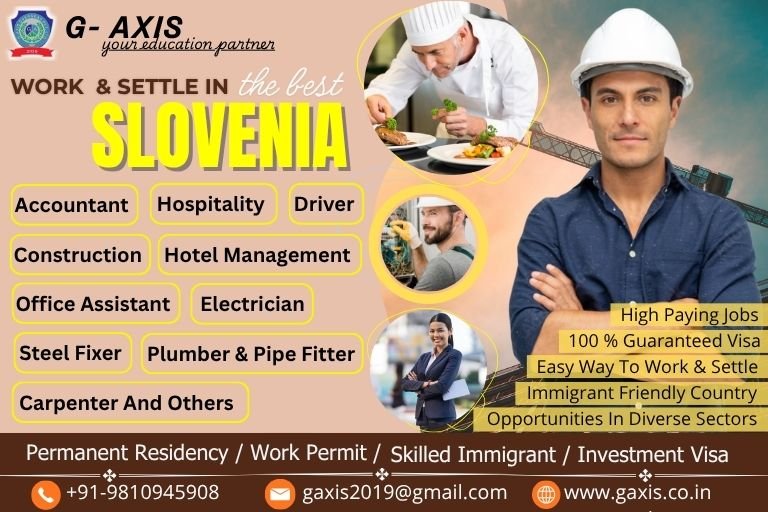
4. Strong Labor Demand: Due to local labor shortages, there is high demand for foreign workers in sectors like IT, healthcare, manufacturing, construction, logistics, and hospitality.
5. Language & Culture: While Slovenian is the official language, many people speak English well, especially in business environments, making it relatively easy for expats to communicate.
6. Central Location: Its location in the heart of Europe makes it an excellent base for travel to neighboring countries like Italy, Austria, Hungary, and Croatia.
1. Breathtaking Nature & Landscapes: Featuring the stunning Julian Alps, Triglav National Park, and pristine turquoise rivers like the Soča, Slovenia offers immense natural beauty in a small, accessible area.
2. Iconic Lake Bled & Bohinj: Famous for its emerald-green lake, island church, and cliff-top castle, Bled is a fairy-tale destination, while Lake Bohinj offers a more serene, wilder alternative.
3. Ljubljana – The Green Capital: Slovenia’s capital is a charming, pedestrian-only city known for its café culture, Baroque architecture, and title as one of Europe’s greenest, cleanest cities.
4. Outdoor Adventure All Year: Whether hiking in summer, skiing in winter, or cycling through vineyards, the country is a paradise for outdoor enthusiasts.
5. Spectacular Caves & Karst: The Postojna Cave system and the UNESCO-listed Škocjan Caves offer mesmerizing underground experiences.
6. Unique Culinary Scene & Wine: Slovenia is a rising food destination with Michelin-starred restaurants, excellent local wine regions, and a deep, traditional honey culture.
7. Unspoiled Coastal Towns: Piran and other coastal towns offer Mediterranean charm, Venetian architecture, and beautiful Adriatic sunsets.
8. Sustainability & Eco-Friendly Travel: As a leader in sustainable tourism, visitors can enjoy guilt-free travel with a high focus on nature preservation.
9. Rich History & Castles: From Ljubljana Castle to Predjama Castle built into a cave mouth, the country is dotted with, historic sites, and charming old towns.
10. Safety & Accessibility: Ranked as one of the safest countries in the world, it is also centrally located, making it easy to travel from neighboring Italy, Austria, and Croatia.
Non-EU/EEA nationals require a “Single Residence and Work Permit” to live and work in Slovenia, which is usually applied for by the employer or the employee at an administrative unit (Upravna enota). The process requires a signed job contract, valid passport, health insurance, and a clean criminal record.
Application Method: The application for a single permit can be submitted at the administrative unit in Slovenia or at a Slovenian diplomatic mission abroad.
1. Valid passport (valid at least 3 months longer than the intended stay).
2. Signed employment contract or work invitation.
3. Proof of sufficient financial means (at least the basic minimum income in Slovenia).
4. Health insurance coverage.
5. Police clearance certificate (criminal background check) from your home country.
6. Passport photos and, if necessary, fingerprints.
1. Single Permit: Covers both residence and work for a specific employer.
2. EU Blue Card: For highly qualified workers with higher education and a specific salary threshold.
3. Seasonal Work Permit: For agricultural/tourism work, valid for up to 6 months (or 7 months in special cases).
Salaries in Slovenia are considered decent to good, offering a high quality of life with a strong work-life balance and a lower cost of living compared to Western Europe. As of 2024–2025, the average net monthly salary is approximately €1,500–€1,600, with gross salaries around €2,300–€2,500, though high-skilled sectors like IT can offer significantly more.
Key Salary Details in Slovenia
1. Average Earnings: The average monthly gross salary is approximately €2,591 (net €1,626).
2. Net Minimum Wage: The net minimum wage is approximately €900–€1,000 per month.
3. Income Range: Employees generally earn between €1,411 and €3,632+ gross per month, depending on the industry and experience.
4. High-Demand Sectors: IT, healthcare, construction, manufacturing, and hospitality offer solid earning potential.
5. Cost of Living: While rental prices, particularly in Ljubljana, have increased, the overall cost of living is lower than in neighbouring countries like Italy or Austria.
1. Software Developers
2. Applications Programmers
3. IT Support Specialists
4. Cybersecurity Specialists
5. Data Scientists
6. AI/Machine Learning Engineers
7. General/Specialist Medical Practitioners (Doctors)
8. Nurses (Registered)
9. Nursing Associate Professionals
10. Physiotherapists
11. Health Care Assistants/Caregivers
12. Dentists
13. Pharmacists
14. Mechanical Engineers
15. Electrical Engineers
16. Civil Engineers
17. CNC Operators
18. Machine Operators (Production)
19. Welders and Flame Cutters
20. Toolmakers
21. Electricians
22. Plumbers and Pipe Fitters
23. Construction Workers/Builders
24. Painters and Related Workers
25. Professional Drivers (Truck/HGV/Bus)
26. Warehouse Workers/Logistics Staff
27. Chefs and Cooks
28. Waiters and Waitresses
29. Cleaners and Housekeeping Staff
30. Teachers
Lifestyle in Slovenia is widely considered excellent, offering a high quality of life with a safe, clean, and slow-paced environment. It boasts stunning natural beauty (Alps to Adriatic sea), strong community ties, and a good work-life balance. It is particularly favored by families and retirees, although it has a high cost of living, significant bureaucracy, and, for some, a reserved culture.
Here is a detailed breakdown of the lifestyle in Slovenia:
1. Safety and Environment: Slovenia is exceptionally safe, with one of the lowest homicide rates in the EU and low general crime rates. The country is clean, with 60% of its territory covered by forests.
2. Nature and Outdoor Activities: The lifestyle heavily features outdoor recreation, including hiking in the Julian Alps, skiing, and visiting the Adriatic coast.
3. Cost of Living and Economy: While offering a good life, Slovenia has become more expensive, especially regarding housing in cities like Ljubljana. The average net salary is around €1,626 as of June 2025.
4. Culture and People: Life is described as relaxed, with a, strong cafe culture. People are generally described as hardworking, direct in speech, and sometimes reserved, though they are hospitable.
5. Health and Education: The country offers good quality, accessible healthcare and education, although some residents report long waiting times for specialists.
6. Location: Situated in Central Europe, it offers easy access to Italy, Austria, Hungary, and Croatia.
Now you have solid basics to move to Slovenia, of course, there is some research and preparation ahead of you however if you have any questions don’t hesitate and contact us. We will be happy to help you!
can help – fill in your details and we’ll call you back.
Chat Now