
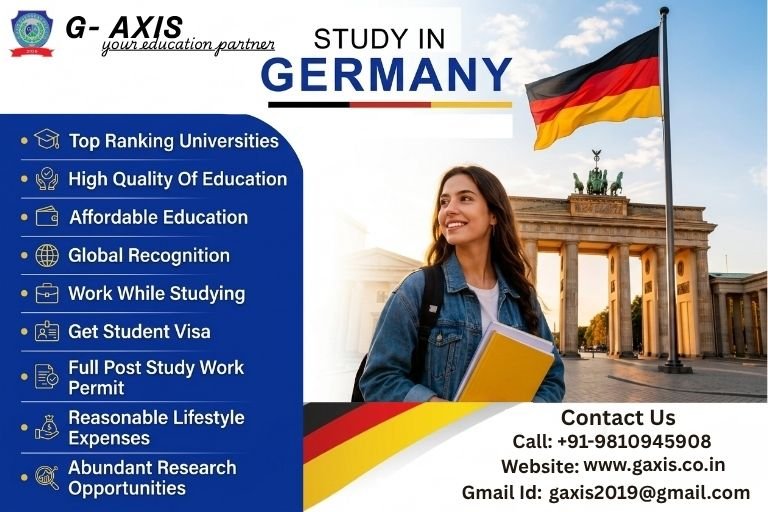
Germany is a highly developed and influential nation situated in North-Central Europe. As Europe’s largest economy and its second most populous country, it is renowned for its excellence in engineering, rich history, and pivotal role within the European Union. Berlin serves as its capital, and German is the primary language spoken here. While the cost of living in Germany is generally considered higher compared to many other nations, it is often more affordable when compared to other major European countries such as Switzerland or Denmark.
Germany is regarded as one of the safest countries in the world; it consistently ranks high on global peace indices and boasts a very low rate of violent crime. Pursuing an education in Germany is highly esteemed, as its public universities offer high-quality—and often tuition-free—education, place a strong emphasis on practical learning, and facilitate easy post-graduation employment opportunities for international students. It ranks as the third most popular destination for international students globally, offering a wide array of courses taught in English, a relatively low cost of living, and an 18-month post-study work visa upon graduation. Currently, India leads the way among countries sending international students to Germany; Indian nationals hold the highest number of student visas and account for the largest share of university enrollments.
1. Official name: Federal Republic of Germany
2. Location: Central Europe, bordered by nine nations (Denmark, Poland, Czech Republic, Austria, Switzerland, France, Luxembourg, Belgium, and the Netherlands) with coastlines on the North and Baltic Seas.
3. Area: Approximately 357,022 to 357,596 km2
4. Capital: Berlin
5. Currency: Euro
6. Languages: German (official)
7. Economy: Largest in Europe and fourth-largest globally, driven by automotive, engineering, technology, and chemical industries
8. Total population: Estimated at approximately 83.6 million to 84.1 million
1. Tuition-Free Education: Public universities charge no tuition fees for international students, with only nominal administrative fees per semester.
2. High-Ranked Universities: Germany boasts top-tier academic institutions with globally recognized degrees.
3. Strong Economy & Career Prospects: As Europe’s largest economy, it offers excellent job opportunities in engineering, IT, and healthcare.
4. Affordable Cost of Living: Compared to other Western European nations, living expenses for students are relatively low.
5. Part-Time Work Rights: Students can work part-time (120 full days or 240 half days per year) to support their studies.
6. Innovative Environment: A global leader in R&D, engineering, and “Industry 4.0,” fostering innovation.
7. English-Taught Programs: A wide range of international, English-taught programs is available, especially at the Master’s level.
8. Safety and Stability: Germany is a very safe country with high levels of political and economic stability.
9. Central Location & Travel: Located in the heart of Europe, making it easy to travel to neighboring countries by rail or air.
10. Rich Culture & Quality of Life: Offers a high standard of living, vibrant cultural scenes, and historic, multicultural cities.
1. High-Quality Education & Research: German universities are renowned for their high academic standards and close ties to industry, especially in fields like engineering, technology, and science.
2. English-Taught Programmes: A vast number of Master’s and a growing number of Bachelor’s programmes are offered entirely in English, removing language barriers.
3. Post-Study Opportunities: Graduates can stay for up to 18 months to find a job related to their studies, with excellent career prospects in a large, stable economy.
4. Affordable Cost of Living: While prices vary, Germany offers a relatively affordable cost of living for international students compared to other Western European nations or the USA.
5. Work Opportunities for Students: Students are permitted to work, allowing them to gain experience and help support their studies (up to 120 full or 240 half days per year).
Key Stages of the German Education System
1. Preschool (Kindergarten/Kita): Not compulsory, for children under 6. While a spot is guaranteed from age 1, finding a place can be competitive.
2. Primary School (Grundschule): Usually Grades 1-4 (ages 6–10), or up to Grade 6 in Berlin and Brandenburg.
3. Secondary Education (Secondary I & II): After primary school, students are divided into different paths, typically based on academic performance:
1. Technical University of Munich (TUM)
2. Ludwig-Maximilians-Universität München (LMU)
3. Heidelberg University
4. Humboldt-Universität zu Berlin
5. Freie Universität Berlin
6. RWTH Aachen University
7. Karlsruhe Institute of Technology (KIT)
8. Technische Universität Berlin (TU Berlin)
9. Universität Hamburg
10. Albert-Ludwigs-Universität Freiburg
11. Charité – Universitätsmedizin Berlin
12. Goethe University Frankfurt
13. TU Dresden
14. University of Göttingen
15. Eberhard Karls Universität Tübingen
16. Universität Bonn
17. University of Cologne
18. Universität Stuttgart
19. University of Münster
20. Friedrich-Alexander-Universität Erlangen-Nürnberg (FAU)
1. Computer Science and IT: Focuses on AI, software engineering, and cybersecurity, with high demand in tech hubs.
2. Mechanical and Automotive Engineering: World-renowned, with strong ties to brands like VW and BMW.
3. Data Science and Business Analytics: Growing field with excellent placement in finance and tech sectors.
4. Business Administration and Management: Includes International Management and MBA programs.
5. Engineering Management (Wirtschaftsingenieurwesen): Combines engineering and business for management roles.
6. Renewable Energy and Sustainability: Germany is a leader in green technology and energy transition.
7. Medicine and Dentistry: Highly prestigious with top-tier research opportunities, though often requiring German language proficiency.
When to Apply
1. Winter Semester (Main intake): Classes start in October. Applications are generally open from May to 15 July.
2. Summer Semester: Classes start in March/April. Applications are generally open from December to 15 January.
3. Recommendation: Apply as early as possible (at least 6 weeks before the deadline) to allow time for visa processing and document corrections.
How to Apply – Step-by-Step
1. Select Program & Check Prerequisites:
2. Get APS Certificate (For Indian, Chinese, Vietnamese Students): Secure the APS certificate early, as it can take months, which authenticates educational documents.
3. Language Proficiency: Obtain required scores for English (IELTS/TOEFL) or German (TestDaF/DSH/Goethe).
4. Submit Application: Apply directly through the university’s own portal or through uni-assist (the portal for international applications).
5. Required Documents: Typically, this includes a certified copy of your diploma, transcript of records, CV, passport photo, and language certificates.
6. Secure Funding & Visa: After receiving an admission letter, open a Blocked Account to show proof of funds and apply for a student visa.
Key Eligibility Criteria
1. Academic Qualification (HZB):
Bachelor’s: A school-leaving certificate equivalent to German Abitur. If not equivalent, you may need a one-year Studienkolleg (preparatory course) and a Feststellungsprüfung exam.
Master’s: A relevant undergraduate bachelor’s degree (often with a high GPA/2.0 on a 4.0 scale).
2. Language Proficiency:
German-taught programs: Generally need DSH-2, TestDaF (TDN 4), or Goethe Certificate C2.
English-taught programs: Generally need IELTS (6.5+) or TOEFL (80-100+).
3. APS Certificate: Mandatory for applicants from certain countries (e.g., India) to verify academic documents.
4. Financial Proof: Evidence of funding, typically a blocked account (Sperrkonto), proving you can cover living expenses.
5. Health Insurance: Proof of statutory or private insurance is mandatory for enrollment.
1. University Entrance Qualification (HZB)
2. APS Certificate
3. Language Proficiency Certificate
4. Curriculum Vitae (CV)
5. Statement of Purpose (SOP)/Motivation Letter
6. Passport
7. Passport Photo
8. Letters of Recommendation (LORs)
9. Certificate of Enrollment/Removal
10. Work/Internship Experience
1. Winter Intake (Main Intake/Fall Semester):
2. Summer Intake (Secondary Intake):
1. DAAD Scholarship (German Academic Exchange Service): The premier program for international students, offering full funding (approx. €850–€1,200/month), tuition coverage, and health insurance for master’s and doctoral candidates.
2. Deutschlandstipendium (National Scholarship): Provides €300 per month (split between the government and private donors) to high-achieving students, regardless of nationality or income.
3. Heinrich Böll Foundation Scholarships: Awards approx. €850–€1,200+ per month to international master’s and PhD students, particularly those focused on environmental studies, sustainable development, and social justice.
4. Konrad-Adenauer-Stiftung (KAS) Scholarships: Targets international master’s and PhD students with high academic performance and social/political engagement, offering roughly €992–€1,400 per month.
5. Friedrich Ebert Stiftung Scholarship: Supports students from developing countries and emerging markets who have good academic records and are dedicated to social and democratic causes.
Tuition Fees:
1. Public Universities: Free (except for a semester fee covering administration and public transport).
2. Baden-Württemberg Public Universities: €3,000 per year for non-EU students.
3. Private Universities: €5,000 – €20,000+ per year.
Living Expenses (Blocked Account Requirement): As of 2026, students must show at least €992 per month (€11,904/year) to cover accommodation, food, and insurance.
Semester Fee: €200–€450 (approx. ₹18,000–₹40,000) per semester, often covering a transportation ticket.
Popular Part-Time Job Options
1. Academic/Student Assistants (HiWi): Positions at universities, such as library supervisors or research assistants, which often pay €14–€20/hour.
2. Minijobs: These jobs (earning up to ~€603/month in 2026) are very common, often covering retail, cleaning, or hospitality.
3. Hospitality & Service: Waiter/waitress, bartender, or service staff at cafes and events.
4. Delivery Services: Working as a courier for companies like Lieferando or Wolt.
5. Tutoring: Private tutoring can pay well, often €15–€35/hour.
1. Software Developer/Engineer
2. Data Scientist/AI Specialist
3. Cybersecurity Expert
4. Cloud Engineer/Architect
5. IT Project Manager
6. Mechanical Engineer
7. Automotive Engineer
8. Electrical/Electronic Engineer
9. Civil/Structural Engineer
10. Industrial Engineer/Manager
11. Physician/Specialist Doctor
12. Nursing Professional
13. Pharmaceutical Researcher/Biotechnologist
14. Healthcare Manager/Administrator
15. Financial Analyst/Fintech Specialist
16. Management Consultant
17. Human Resources (HR) Manager
18. Accountant/Tax Consultant
19. Renewable Energy Engineer/Specialist
20. Logistics & Supply Chain Manager
1. World-Class Education: Australia hosts top-ranked universities known for research-focused learning and academic excellence.
2. Post-Study Work Opportunities: Graduates can apply for post-study work visas (e.g., Temporary Graduate visa subclass 485), allowing them to gain work experience in Australia.
3. High Standard of Living: Australian cities (e.g., Melbourne, Sydney, Brisbane) are safe, clean, and offer high-quality infrastructure and healthcare.
4. Multicultural Society: A diverse, welcoming environment with students from around the globe, making it easy to fit in.
5. Part-Time Work Opportunities: International students can work part-time (typically up to 48 hours per fortnight during semesters) to help fund their stay.
Please contact us for more guideline and VISA apply.
can help – fill in your details and we’ll call you back.
Chat Now