
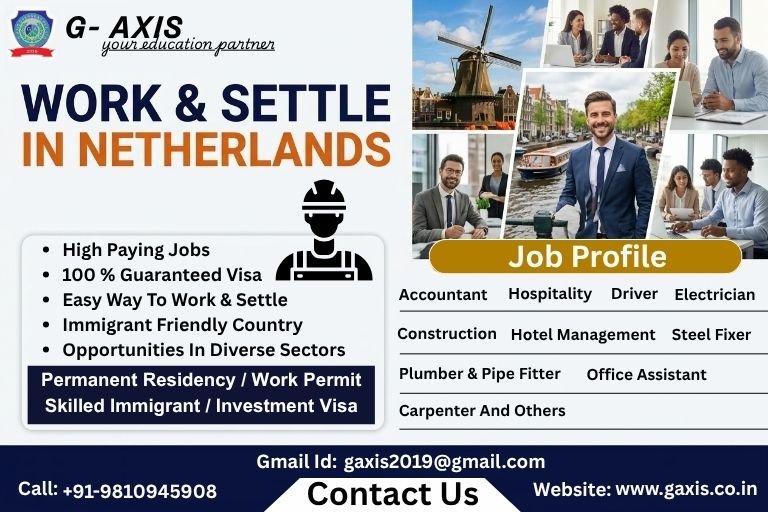
The Netherlands is a country in Northwestern Europe, with its name literally translating to “low-lying country” or “low countries” due to its flat terrain and extensive areas below sea level. Working and settling in the Netherlands offers an excellent quality of life, driven by a, perfect work-life balance, high English proficiency, and strong job security.
The Netherlands is world-famous for its iconic tulip fields, historic windmills, intricate canal systems (particularly in Amsterdam), and cycling culture, Germany is the leading country of origin for tourists visiting the Netherlands, consistently ranking first, with over 5 million visitors in recent years. The Netherlands is a global economic powerhouse, consistently ranking among the top 20 largest economies (18th by nominal GDP) and boasting one of the highest per capita incomes.
1. Official Name: Kingdom of the Netherlands
2. Location: The Netherlands is a country in Northwestern Europe bordered by the North Sea to the north and west, Germany to the east, and Belgium to the south.
3. Area: Approximately 41,850 sq km (16,160 sq mi), with about 18–19% consisting of water.
4. Capital: Amsterdam
5. Currency: The Euro (€) is the official currency in the European Netherlands.
6. Languages: Dutch is the primary official language.
7. Economy: The Netherlands has a highly developed, export-driven economy that serves as a major European trading, logistics, and technology hub, often ranked among the world’s most competitive and affluent nations.
8. Total Population: Estimated at approximately 18.2 to 18.3 million as of early 2026.
Permanent residence (PR) in the Netherlands is a status allowing non-EU/EEA nationals to live and work in the country indefinitely without needing to renew their permit, usually granted after 5 years of legal, continuous residence.
1. Five-Year Residency: You must have held a valid, non-temporary residence permit for at least five consecutive years, living in the Netherlands, and registered in the Personal Records Database (BRP).
2. Valid Purpose: Your current permit must be for a non-temporary purpose (e.g., work, family reunification, but not study).
3. Income Requirement: You must demonstrate a stable and sufficient income, usually meeting minimum wage requirements, to support yourself.
4. Civic Integration: You must pass the civic integration exam (minimum A2 level) to prove proficiency in the Dutch language and knowledge of Dutch society, unless exempt.
5. No Criminal Record: You must not pose a threat to public order or safety.
1. Unlimited Stay: Live and work without needing to renew your permit every few years.
2. Independent Work: Free access to the Dutch labor market, often without needing a work permit (TWV).
3. Stability: Provides long-term security and the right to bring family members.
Renew your permanent residence permit (Type II or V) in the Netherlands by replacing the physical document every 5 years, as the document expires but the residency status does not.
Key Renewal Steps:
1. Timeline: Apply up to 3 months before your current card expires to avoid lapses.
2. Method: Use the online portal with DigiD (fastest) or submit a paper form by post.
3. Permanent Permits (Type II/V): These do not expire, but the card must be renewed every 5 years.
4. Requirements: You must maintain your main residence in the Netherlands, have a valid passport, and not have received a conviction.
5. Process: Fill in form 6013 for renewal, pay the fee, and make an appointment with the IND to collect your new card.
1. Long-Term Absence: A permanent residence permit becomes invalid if you live outside the Netherlands for more than 5 consecutive years.
2. Moving Outside the EU: Moving your main residence outside the European Union can lead to losing your permit.
Here are some pros and cons of living in the Netherlands:
| Pros of Living in the Netherlands | Cons of Living in the Netherlands |
| Beautiful scenery and amazing architecture. | Expensive cities and living conditions. |
| Ability to work part-time. | Hard to find a job due to the competition. |
| Many jobs offer working from the comfort of your own home. | High population number. |
| Low crime rates. | High tax payment system. |
| Highly experienced doctors and nurses. | Expensive health care system. |
| Cycling system and no air pollution. | Stores close too early. |
| Balance of work and life. | Work visas are hard to obtain. |
| Dutch people speak English perfectly. | Dutch-speaking communities may make you feel left out. |
| A month of paid vacation. | High credit card interest rates. |
1. Job Market & Sectors: High demand exists for talent, especially in IT, technology, healthcare, and engineering. Temporary agencies are common for finding work.
2. Work-Life Balance: The Netherlands is renowned for a 36-40 hour work week, flexible schedules, and generous holiday allowances.
3. Language & Culture: English is widely spoken, making it possible to work, particularly in multinational companies or specialized sectors, without immediate fluency in Dutch.
1. Software Engineer / Developer (Java, Python, Frontend/Backend)
2. Machine Learning/AI Engineer
3. Data Engineer / Scientist
4. Electrical Engineer
5. Logistics Warehouse Coordinator / Planner
6. Specialist Nurse / Healthcare Professional
7. Supply Chain Manager
8. Account Manager / Executive (Sales)
9. Product Designer
10. Financial Analyst / Accountant
11. Digital Marketing Specialist
12. DevOps / Site Reliability Engineer
13. Customer Success Specialist
14. Mechanical Engineer
15. Project Manager (Tech/Construction)
16. Business Analyst
17. Cyber Security Specialist
18. HR Operations Specialist
19. Content Creator / Social Media Specialist
20. Technical Support Technician
1. The average annual salary in the Netherlands is approximately €42,000–€55,000 gross, with a median monthly income around €3,145.
2. Low-income earners, typically minimum wage workers, earn about €14.06 per hour (~€2,400+ per month for full-time) for those 21+.
1. Work-Life Balance: The Dutch prioritize life outside of work, with many working part-time or 4-day work weeks, particularly in 9-hour shifts to maximize efficiency. Evenings and weekends are considered private, and working late is seen as poor planning rather than dedication.
2. Flat Hierarchy: There is a minimal power distance, allowing employees to openly voice opinions to superiors. Communication is straightforward, known as “Dutch directness,” which values honesty and efficiency, sometimes appearing blunt to outsiders.
3. Consensus-Oriented (Poldermodel): Decision-making often involves significant discussion to ensure everyone is on board, which can sometimes be time-consuming.
4. Professionalism & Informality: While meetings are on time and tasks are efficiently managed, the atmosphere is usually casual.
1. Employment Contracts: While verbal agreements are valid, employers must provide a written statement of terms (hours, salary, job description, probation).
2. Wages: As of Jan 1, 2024, a mandatory minimum hourly wage applies to all employees (aged 21+), with reduced rates for those under 21.
3. Working Hours & Rest: Maximum 12 hours/day and 60 hours/week, with a 48-hour average over 16 weeks. Daily rest must be at least 11 consecutive hours.
4. Leave Entitlements: Employees receive at least four times their weekly working hours in annual vacation time. Paid pregnancy leave (16 weeks) and partner leave (up to 6 weeks) are standard.
5. Sick Pay: During illness, employers must pay at least 70% of the salary for up to two years, though many contracts offer 100% in the first year.
Work visas in the Netherlands are permits allowing non-EU/EEA/Swiss nationals to legally work and live in the country
Key Netherlands work visa types include:
1. Highly Skilled Migrant: For employees with a specialized skill set and a job offer from an IND-recognized sponsor.
2. EU Blue Card: For highly qualified, non-EU professionals with a valid work contract (at least 1 year) and high salary.
3. Combined Residence and Work Permit (GVVA/Single Permit): A standard permit combining residence and work, often used for general employment.
4. Intra-Corporate Transfer (ICT): For professionals transferring to a Dutch branch within their multinational company.
5. Orientation Year: A one-year job-seeker visa for graduates from top universities to find employment.
6. Self-Employment/Entrepreneur Permit: For individuals starting their own business.
7. Seasonal Work Permit: Temporary authorization for specific industries.
1. Valid Passport
2. Completed Visa Application Form
3. Job Offer/Employment Contract
4. Passport-Sized Photographs
5. Birth/Marriage Certificate
6. Educational Certificates/CV
7. Criminal Record Check
1. Secure a Job Offer: A Dutch employer must offer you a position. Many work permits require the employer to be a “recognized sponsor” (recognized by the IND).
2. Employer Applies on Your Behalf: In most cases, you cannot apply for a work permit yourself. The employer submits the application to the Immigration and Naturalization Service (IND).
3. Obtain a Combined Permit (GVVA): Most foreign workers receive a single permit (GVVA), which combines the residence permit and the work permit.
4. Visa Approval (MVV): If you are outside the Netherlands, you may need a provisional residence permit (MVV) to enter the country.
5. Register on Arrival: Upon arrival, you must register with your local municipality to obtain a BSN (Citizen Service Number) for tax and health insurance purposes.
1. Exceptional Work-Life Balance: The Netherlands boasts one of the shortest average workweeks in Europe. There is a strong cultural and legal emphasis on flexibility, allowing employees to maintain a healthy balance between their professional and personal lives.
2. World-Class Cycling Infrastructure: With an extensive and safe network of dedicated bike lanes, cycling is the preferred, healthy, and eco-friendly way to commute and live.
3. High Level of Safety and Security: The country is one of the safest in the world, with low crime rates and high security for residents, making it an ideal place for families and children.
4. Excellent Healthcare System: The Dutch healthcare system is recognized as one of the best globally, ensuring high-quality, accessible medical care for all residents.
5. High English Proficiency: As the world’s highest non-native English speaking population, it is very easy for expats and internationals to communicate and live without immediately speaking fluent Dutch.
6. Progressive and Inclusive Society: The Netherlands is known for its open-minded, tolerant culture, with strong protections for LGBTQ+ rights, gender equality, and diverse lifestyles.
7. Reliable Public Transportation: An efficient and comprehensive network of trains, trams, buses, and metros makes traveling within cities and across the country convenient, often reducing the need for a car.
8. Child-Friendly Environment: Consistently ranked among the best places to raise children, the education system is top-tier, and the culture supports a relaxed, safe upbringing.
9. Strong Economy and Career Opportunities: As a thriving, stable economy, the Netherlands offers ample job opportunities, particularly in tech, finance, and logistics, along with attractive tax benefits like the “30% ruling” for skilled migrants.
10. Quality Urban Design and Green Space: Dutch cities are meticulously planned, combining historic architecture with modern, green areas.
can help – fill in your details and we’ll call you back.
Chat Now