
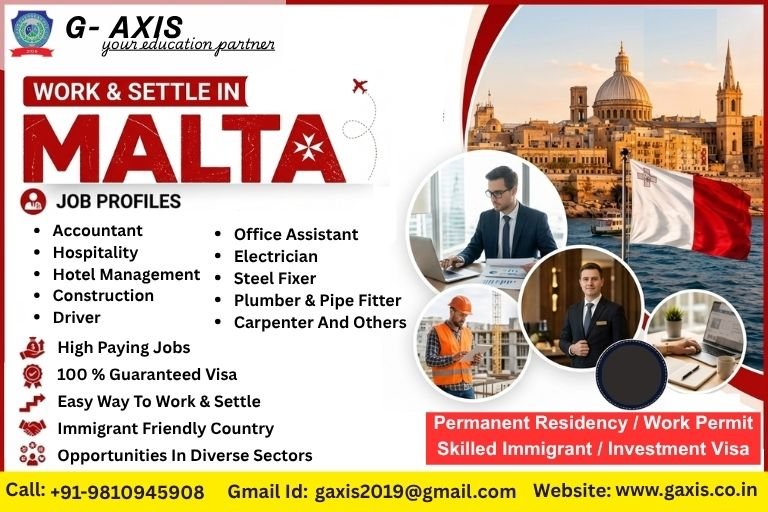
Malta is a tiny, sunny island country in the middle of the Mediterranean Sea, located south of Sicily, Italy. It is a member of the European Union, famous for its 7,000 years of history, stunning beaches, and300+ days of sunshine. Both Maltese and English are official languages, making it easy for tourists to visit. Malta is a strong destination for foreign workers, economy with high demand for skills in tech, finance, iGaming, and healthcare. As a melting pot of cultures, it offers visitors a unique blend of ancient ruins, medieval cities, and crystal-clear waters.
Italy is currently the top source market for tourists visiting Malta, leading in inbound visitor numbers during 2024. Malta has a small, high-income economy, ranked approximately 118th–125th globally by nominal GDP ($22.7B–$24.97B).
1. Official name: Republic of Malta
2. Location: An archipelago in Southern Europe, situated in the central Mediterranean Sea. It lies approximately 93 km (58 miles) south of Sicily, Italy, and roughly 300 km north of North Africa.
3. Area: Total land area of 316 square kilometres (approximately 122 square miles).
4. Capital: Valletta
5. Currency: Euro (€)
6. Languages: Maltese (the national language) and English are both official languages.
7. Economy: An advanced, high-income economy heavily reliant on tourism, financial services, online gaming, maritime trade, and pharmaceuticals.
8. Total population: Estimated at approximately 574,250 as of 2024/2025.
1. English-Friendly Environment: English is an official language, making it easy for expats to navigate daily life, work, and banking.
2. Safety and Security: Malta is ranked among the safest countries in Europe with very low crime rates.
3. Ideal Climate: Enjoy over 300 days of sunshine, with mild winters and hot summers perfect for outdoor living.
4. Stunning Beaches & Scenery: The archipelago offers beautiful beaches, rocky coves, and crystal-clear waters.
5. Strategic Location: Located in the center of the Mediterranean, providing easy access to Europe, Sicily, and North Africa.
6. Rich Cultural History: A UNESCO World Heritage hub with 7,000 years of history, including Valletta and ancient temples.
7. Active Expat Community: A large, welcoming, and diverse international population makes it easy to socialize and network.
8. Affordable Quality of Life: Generally lower cost of living compared to many Western European nations, with affordable dining and local goods.
9. Strong Economy & Job Opportunities: Excellent career prospects in iGaming, finance, and tourism sectors.
10. Small Island Convenience: Its small size means everything is accessible; you can be at the beach within 15–30 minutes of leaving work.
11. Quality Healthcare: Residents have access to high-standard public and private medical facilities.
12. Relaxed Lifestyle: A “slow-paced” Mediterranean atmosphere encourages a healthy work-life balance.
13. Vibrant Nightlife and Dining: Areas like St. Julian’s and Sliema offer bustling restaurants, bars, and clubs.
14. Gozo’s Alternative Pace: The smaller sister island of Gozo offers a quieter, rural, and more traditional lifestyle.
15. EU Benefits: As a member of the EU and Schengen area, it allows easy travel and business within Europe.
The Malta Permanent Residence Programme (MPRP) is a government-regulated, investment-based immigration program that grants non-EU nationals the right to live, settle, and stay in Malta indefinitely. It offers visa-free travel within the Schengen Area, requires no minimum physical stay, and allows applicants to include4 family generations, including spouse, children, parents, and grandparents.
1. No Mandatory Physical Residency: Unlike many other programs, you do not have to live in Malta to keep your residency status, making it ideal for high-net-worth individuals.
2. Schengen Access: Holders can travel without a visa within the Schengen Area for up to 90 days out of every 180.
3. Duration: The residence card is valid for 5 years and renewable indefinitely, provided the applicant maintains a property (rented or owned) and valid insurance.
4. Path to Citizenship: While it is a permanent residency program, holders can apply for Maltese citizenship after 5 years of legal residence.
1. Applicant Eligibility: Must be a third-country national (non-EU/EEA/Swiss), at least 18 years old, and pass a 4-tier due diligence process.
2. Financial Requirements:
Capital Assets: Minimum of €500,000 in assets, with at least €150,000 in financial assets.
Contribution Fee: A non-refundable government contribution of €30,000 if leasing property, or €60,000 if purchasing property.
Government Administrative Fee: A non-refundable fee of €5,500 (part of the contribution).
3. Property Requirement (Must hold for 5 years):
Rent: Minimum of €12,000 per annum in Malta or €10,000 in Gozo/South Malta.
Purchase: Minimum of €350,000 in Malta or €300,000 in Gozo/South Malta.
4. Additional Costs: A €2,000 donation to a registered NGO and €5,000 for each additional parent/grandparent dependent.
5. Documentation: Valid passport, proof of source of funds, comprehensive health insurance for all, and police clearance certificates.
1. Applications must be submitted through a licensed agent (accredited agent).
2. The process includes a thorough background check (due diligence) to verify the legality of funds.
3. Annual compliance checks are required for the first 5 years.
Malta residency programs, primarily the Malta Permanent Residence Programme (MPRP), are government-approved investment schemes allowing non-EU citizens to acquire legal residency in Malta, providing visa-free travel across the Schengen Area. These programs offer lifetime residency for the applicant and family without requiring, in many cases, a minimum physical stay.
Key Features and Benefits
1. Permanent Residency: The MPRP grants indefinite residency rights.
2. Schengen Access: Visa-free travel within the Schengen Area for 90 days out of 180.
3. Family Inclusion: Covers up to four generations: applicant, spouse, children, and dependent parents/grandparents.
4. No Minimum Stay: No requirement to live in Malta, making it an ideal “Plan B”.
5. Property & Investment Requirements: Applicants must either rent or purchase property and make a non-refundable government contribution.
Malta fully permits dual and multiple citizenship, allowing individuals to acquire Maltese citizenship without renouncing their original nationality. Since February 10, 2000,, it has been legal to hold Maltese citizenship alongside another. This status provides EU citizenship rights, visa-free travel to over 180 countries, and the right to live/work in Malta and the EU.
1. Proof of Identity & Status: Valid passport, birth certificate, and marriage/civil union certificate.
2. Background Checks: Police clearance certificates from all countries resided in, ensuring good character.
3. Residence & Address Proof: Rental agreement or property purchase contract in Malta, alongside utility bills or a residence card.
4. Financial Documentation: Bank statements (typically covering the last 6 months), tax returns, and evidence of the source of funds.
5. Health Documentation: A certificate from a reputable health system confirming good health and comprehensive health insurance coverage.
6. Specific Applications: A detailed CV, application forms (e.g., K, ID 1A), and a motivation letter for citizenship by investment, or proof of 6 years of residence for citizenship by descent.
1. Citizenship by Investment: Requires higher investment (€600k-€700k+ contribution + property) but faster, usually 12-36 months.
2. Citizenship by Marriage: Requires proving marriage and cohabitation for at least 5 years.
3. Citizenship by Naturalisation: Requires 5-7 years of legal residency.
Immigration to Malta is generally considered very positive, offering a high quality of life, a stable economy, and seamless access to the European Union. Key advantages include visa-free travel within the Schengen Area, a warm Mediterranean climate, English-speaking environment, and favorable tax regimes.
Key Reasons Why Immigration to Malta is Attractive:
1. Residence & Citizenship Options: The Malta Permanent Residence Programme (MPRP) and Global Residence Programme offer pathways for non-EU nationals to live, work, and retire there.
2. Mobility: Residents gain visa-free access to 29 European countries in the Schengen Area.
3. Family Inclusion: Programs often allow for up to four generations of family to be included, including dependent parents and grandparents.
4. Economic Opportunities: Growing industries like gaming, financial services, and IT create a strong demand for foreign labor.
5. Quality of Life: Malta features a low crime rate, top-tier healthcare, and a rich cultural scene.
Working in Malta is generally very good for international workers, offering a,,growing economy, English-speaking environment, and high demand in sectors like iGaming, IT, finance, and tourism. It provides a high quality of life, EU-standard labor laws, and a fast-track work permit for highly skilled, non-EU professionals.
Key Advantages for International Workers:
1. Language & Culture: English is an official language, making it easy to integrate into the workplace and society.
2. Job Market Demand: With a low unemployment rate (3.2% in 2024), there is a high demand for skilled foreign workers.
3. Growing Industries: Significant opportunities exist in iGaming, IT/Software Development, financial services, and hospitality.
4. Competitive Salaries & Benefits: While cost of living is rising, salaries, particularly in tech and gaming, are competitive. Employees typically enjoy a 40-hour work week, 25 days of annual leave, and public holidays.
5. Fast-Track Permits: The Key Employment Initiative (KEI) allows for fast-track work permit applications for specialized non-EU nationals.
6. Lifestyle: A Mediterranean climate, safe environment, and high-quality healthcare enhance the overall experience.
| Unskilled Workers |
| Sales Executive |
| Forklift Driver |
| Truck and Forklift Driver |
| Maintenance Technician |
| Marble Cutter |
| Truck / High-up Driver |
| Skilled Workers |
| Machine Operator |
| CNC Marble Cutter |
| Marble Fitter |
| Construction Laborer |
1. Single Permit (D Visa): The standard, combined permit for third-country nationals (TCNs) to live and work, usually valid for over 6 months.
2. EU Blue Card: A specific permit for highly qualified employees with a specialized skill set and higher salary.
3. Key Employee Initiative (KEI): A fast-track service for managerial or technical professionals with a minimum salary, processing in 5 days.
4. Intra-Corporate Transfer (ICT) Permit: For multinational company employees moving to a Maltese branch.
5. Self-Employment/Self-Occupied Permit: For individuals starting a business or working as freelancers.
6. Short-Stay Visa (C Visa): For short-term work engagements, usually lasting less than 90 days.
7. Specialized Permits: Includes specific permits for seasonal workers (tourism/agriculture) and specialized skills passes.
1. Vibrant Job Market & Economy: Malta has a booming,, diverse economy with high demand for skills in iGaming, financial services, blockchain, and tourism.
2. Work-Life Balance & Time Off: The standard work week is 40 hours. Employees are entitled to at least 25 days of paid annual leave.
3. English as a Working Language: English is an official language and spoken by 88% of the population, making it easy to work and settle.
4. Favorable Taxation: Malta offers attractive tax structures for foreign workers and a 15% flat tax rate on income for certain specialized roles.
5. High Quality of Life & Safety: The country boasts a very low crime rate, making it one of the safest in Europe. It also features excellent healthcare and education systems.
6. Cost of Living: Compared to many other European nations, the cost of living in Malta is relatively affordable.
7. Social Security & Benefits: Employees paying social security gain access to public healthcare and, potentially, unemployment benefits.
8. Mediterranean Lifestyle: With 300 days of sun, beautiful beaches, and a rich history, Malta offers a high-quality lifestyle, especially for expats.
The average gross salary in Malta is approximately €2,132 per month (€25,584 annually), resulting in a net monthly income of about €1,669 after deductions. Income tax is progressive (0%–35%), while social security contributions are generally 10% for employees, with a total tax burden that varies based on income bracket.
Lifestyle in Malta is considered excellent, offering a high quality of life driven by over 300 days of sunshine, a relaxed Mediterranean pace, and English-speaking, friendly, and safe surroundings. It provides an ideal work-life balance, featuring easy access to beaches, rich history, and a vibrant, diverse expat community.
1. Climate & Outdoor Life: With 300+ days of sun, the climate allows for year-round outdoor activities like sailing, diving, and hiking, contributing to better mental well-being.
2. Safety & Community: Malta has one of the lowest crime rates in the world, making it very safe, with a welcoming, tight-knit community.
3. Convenience & Language: English is an official language, making it easy for expats to navigate daily life and business. The island is small and compact, reducing commute times.
4. Culture & Environment: Residents enjoy a blend of Mediterranean cuisine, 7,000 years of history, and stunning, accessible coastlines.
5. Cost & Healthcare: While rising, the cost of living remains reasonable compared to other Western countries. The country boasts a high-quality, partly free public healthcare system.
6. Work-Life Balance: The laid-back environment allows for a slower pace of life, often centered around seaside cafes and leisure.
Optimize the chances of success of your submission by getting counseling from the leading immigration consultant that work for you, with you.
can help – fill in your details and we’ll call you back.

Chat Now