
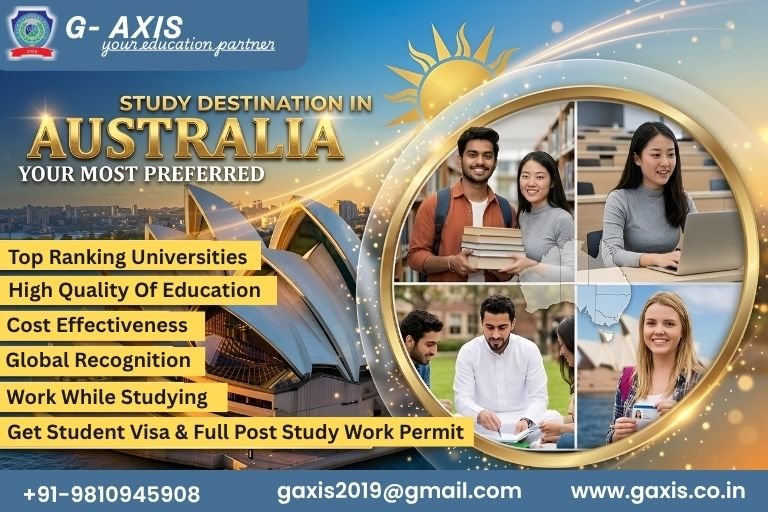
Australia is a country and continent in the Southern Hemisphere, located between the Indian and Pacific oceans. Australia is considered one of the world’s most expensive countries, often ranked within the top 10 globally due to a high cost of living, significant rental expenses, and expensive services. Australia is internationally renowned for its iconic natural wonders, unique wildlife, and vibrant coastal lifestyle.
Australia is considered an excellent study destination, offering high-quality education, globally ranked universities, and a high standard of living. It is popular for its practical, research-focused learning, safe environment, and opportunities for post-study work. Australia is widely regarded as one of the safest countries in the world, often ranking highly for low crime rates, political stability, and high quality of life. China is the top country of origin for international students in Australia, with India and Nepal.
1. Official name: Commonwealth of Australia
2. Location: Located in the Southern Hemisphere between the Indian and Pacific Oceans in the Oceania region. It is the only country that covers an entire continent.
3. Area: Approximately 7,688,287 sq km (roughly 2.97 million square miles), making it the world’s sixth-largest country.
4. Capital: Canberra
5. Currency: Australian dollar (AUD)
6. Languages: English is the de facto National languages
7. Economy: $ 1.950 trillion
8. Total population: Estimated at approximately 28,265,500 as of early 2026.
1. World-Class Education System: Australia offers top-tier universities, with 15 ranking in the top 200 globally, providing qualifications recognized worldwide.
2. Post-Study Employment Possibilities: Graduates can benefit from generous post-study work visas, allowing them to gain work experience in Australia.
3. High Standard of Living: Cities like Sydney, Melbourne, Perth, and Brisbane consistently rank among the most liveable in the world, featuring excellent healthcare and infrastructure.
4. Diverse and Multicultural Environment: As a safe and welcoming nation, Australia is home to people from over 200 countries, offering a vibrant, diverse culture.
5. Unique Natural Landscape & Wildlife: From the Great Barrier Reef to the Outback, Australia offers incredible biodiversity and natural beauty, including iconic wildlife.
6. Strong Employment Opportunities: Australia offers a strong labor market with high part-time wage opportunities for students during their studies.
7. Innovative Research Capabilities: Australian universities are global leaders in research, contributing to advancements in fields like technology, health, and climate science.
8. Safety and Student Support: With stringent consumer protection laws (ESOS Act), Australia is recognized as a safe country for international students and professionals.
9. Modern and Energetic Cities: Australian cities combine urban sophistication with a relaxed outdoor lifestyle, offering bustling cafes, arts, and culture.
10. Pathways to Permanent Residency: Students who complete their studies can explore opportunities for permanent residency (PR), such as skilled migration visas.
1. World-Class Education: Australian universities are renowned for high academic standards and innovative research. They offer a wide variety of courses and qualifications.
2. Globally Recognized Degrees: Qualifications from Australian institutions are respected and accepted by employers worldwide.
3. Post-Study Work Opportunities: Students can gain work experience after graduation through post-study work visas.
4. Quality of Life and Safety: Australia boasts safe, multicultural cities—such as Melbourne, Sydney, and Brisbane—that consistently rank among the world’s most livable.
5. Work While You Study: International students are permitted to work part-time (e.g., 20 hours per week) to help offset living costs.
6. Multicultural Environment: Australia is known for being welcoming to international students, offering a diverse, friendly, and vibrant student life.
7. Stunning Environment and Lifestyle: Students can enjoy diverse landscapes, from golden beaches to rainforests.
1. Structure: Comprises Primary (Prep-Year 6/7), Secondary (Years 7/8-10), and Senior Secondary (Years 11-12).
2. School Types: Government (public, no fees), Catholic (fee-based), and Independent (fee-based).
3. Academic Year: Late January/February to December, split into four terms.
4. Vocational Education and Training (VET): Practical, industry-focused training provided by TAFE institutions or private colleges.
5. Higher Education: University studies offering Bachelor’s, Masters, and Doctoral degrees.
6. AQF Framework: A national 10-level system connecting schools, VET, and higher education for easy movement between qualifications.
7. International Students: Highly ranked globally, governed by the ESOS Act for quality and protection.
1. University of Melbourne (Melbourne) – Ranked #1 in Australia with high research quality.
2. University of Sydney (Sydney) – High industry ranking and top employment rates.
3. University of New South Wales (UNSW Sydney) (Sydney) – Strong focus on STEM and engineering.
4. Australian National University (ANU) (Canberra) – Renowned for research and policy studies.
5. Monash University (Melbourne) – A large, prestigious institution with global research links.
6. University of Queensland (UQ) (Brisbane) – Known for teaching excellence and research.
7. University of Western Australia (UWA) (Perth) – Strong in life sciences and business.
8. Adelaide University (Adelaide) – A Group of Eight member with high research output.
9. University of Technology Sydney (UTS) (Sydney) – Top-ranked young university for technology.
10. RMIT University (Melbourne) – Known for practical, career-oriented education.
1. Nursing & Allied Health: High demand for Registered Nurses and specialists in aged care.
2. Information Technology (IT) & Computer Science: Focus areas include Cybersecurity, Artificial Intelligence, and Data Science.
3. Engineering: Strong demand for Civil, Mechanical, Electrical, and Mining Engineers.
4. Education & Teaching: Critical shortages for Early Childhood, Primary, and Secondary teachers.
5. Social Work & Community Services: Growing demand for qualified professionals in aged care, youth, and disability support.
6. Accounting & Finance: Specialized accounting and financial management remain relevant.
7. Trades (Vocational Education & Training): Essential skills in high demand including Carpentry, Electrical Engineering, and Plumbing.
8. Construction Management & Architecture: Focused on sustainable urban development and large-scale infrastructure projects.
9. Hospitality & Tourism Management: Management and culinary roles in Australia’s thriving hospitality industry.
10. Environmental Science & Sustainability: Focusing on climate change, renewable energy, and environmental management.
University | ||
University of Melbourne | ||
University of Queensland | ||
Macquarie University | ||
Queensland University of Technology | ||
University of Adelaide | ||
RMIT University | ||
University of Western Australia | ||
University of Newcastle | ||
University of Sydney | ||
Australian National University |
Melbourne Business School | ||
UNSW (AGSM) – Australian Graduate School of Management | ||
University of Sydney Business School | ||
University of Sydney Business School | ||
UQ Business School (University of Queensland) | ||
Macquarie Business School (Macquarie University) | ||
Australian National University (ANU) | ||
University of Western Australia (UWA) Business School | ||
Queensland University of Technology (QUT) Business School | ||
University of Technology Sydney (UTS) Business School | ||
RMIT University School of Business and Law |
University | Location | |
Australian National University | Canberra | |
University of Melbourne | Melbourne | |
University of Sydney | Sydney | |
University of New South Wales | Sydney | |
University of Queensland | Brisbane | |
Monash University | Melbourne | |
University of Western Australia | Perth | |
University of Adelaide | Adelaide |
When to Apply: Key Timelines
1. February Intake (Main Intake): Major semester starts. Apply between August and November of the previous year.
2. July Intake (Mid-year): Secondary semester starts. Apply between March and May.
How to Apply: Step-by-Step
1. Choose Course & Institution: Use the Study Australia Course Search tool to find programs.
2. Check Entry Requirements: Check academic eligibility and English proficiency (e.g., IELTS).
3. Submit Application: Apply directly via the university website or an authorized education agent. Prepare documents: Academic transcripts, Passport, CV, and Letter of Recommendation.
4. Accept Offer: Receive an offer letter and pay tuition fees to secure your spot.
5. Confirm Enrolment (CoE): Once fees are paid, the institution issues a CoE, which is required for the visa.
6. Organize Health Cover (OSHC): It is mandatory to arrange health insurance before arrival.
7. Apply for Student Visa (Subclass 500): Apply online via the Department of Home Affairs website.
Academic Requirements:
1. Undergraduate: Completion of Australian Year 12 or equivalent (e.g., CBSE/ISC in India, International Baccalaureate).
2. Postgraduate: A recognized Bachelor’s degree in a relevant field, often with a minimum of 55% to 60%.
3. Competitive Courses: Programs like medicine, law, or engineering may require higher scores (e.g., ATAR 95+ for medical).
English Language Proficiency:
1. Minimum IELTS score is generally 6.5 overall, with no band less than 6.0.
2. Other accepted tests include TOEFL (iBT) and Pearson Test of English (PTE).
Genuine Student (GS) Requirement:
1. Applicants must prove they intend to stay in Australia primarily for study, replacing the former GTE requirement from March 2024.
1. Passport
2. Age Requirement
3. Academic Transcripts & Certificates
4. English Language Proficiency
5. Statement of Purpose (SOP)
6. Curriculum Vitae (CV) / Resume
7. Letters of Recommendation (LORs)
8. Portfolio
9. Work Experience
S.No. | ||
1 | Australia Awards Scholarships (AAS): | Administered by the Department of Foreign Affairs and Trade (DFAT), this fully funded scholarship supports students from developing countries (Asia-Pacific, Africa, Middle East) for undergraduate or postgraduate studies. It covers tuition, return air travel, living expenses, and health cover. |
2 | Research Training Program (RTP): | Funded by the Australian Government for international students pursuing research masters or doctorate degrees (PhD). Covers tuition and stipend for living costs. |
3 | Destination Australia Awards: | Over 1,000 scholarships worth up to AU$15,000 per year for students studying at regional campuses. |
4 | University-Specific Scholarships: | Most Australian universities offer their own merit-based scholarships. Examples include the Sydney Scholars India Equity Scholarship (up to $100,000) and various 50% tuition discounts at universities like Western Sydney University. |
1. | Registered Nurse | ||
2. | Software Engineer | ||
3. | Civil Engineer | ||
4. |
| ||
5. |
| ||
6. |
| ||
7. |
| ||
8. |
| ||
9. |
| ||
10. |
| ||
11. |
| ||
12. | Mining Engineer |
1. Work Entitlements: Work rights begin only once your course has commenced.
2. Hours Limitation: You can work up to 48 hours per fortnight (usually 24 hours/week) while in session.
3. Break Periods: There are no work hour restrictions during scheduled course breaks.
4. Minimum Wage: Students are protected by Australian employment law, with minimum wages often exceeding AUD 22-25 per hour.
5. Exceptions: Postgraduate research students (Masters by research/PhD) often have no work restrictions.
Tuition Fees (Annual)
1. Bachelor’s Degree: AUD 14,000 – 35,000+.
2. Master’s Degree: AUD 15,000 – 36,000+.
3. Engineering/Medicine: AUD 30,000 – 70,000+.
4. Vocational Education (VET/Diploma): AUD 4,000 – 25,000.
5. PhD: Often fully funded or heavily supported, with some ranging AUD 20,000–40,000.
Cost of Living (Per Year)
1. Total Monthly Living Cost: ~AUD 3,000/month.
Key Aspects
1. Academic Culture: Focuses on practical learning, critical thinking, and independent study. Interaction with lecturers is often informal, but attendance is crucial.
2. Accommodation: Options include on-campus residences, shared private rentals, or homestays with local families.
3. Work & Finance: International students can work up to 48 hours per fortnight during semesters and unlimited hours during breaks. Popular industries include hospitality, retail, and healthcare.
4. Cost of Living: Australia can be expensive; students should prepare a budget for rent, food, transport, and, for example, health cover (OSHC).
5. Social Life & Culture: Known for a relaxed, outdoor-oriented lifestyle. Students often spend time at beaches, cafes, and exploring national parks, or participating in university sports and clubs.
Contact us for more information & visa apply
can help – fill in your details and we’ll call you back.

Chat Now