
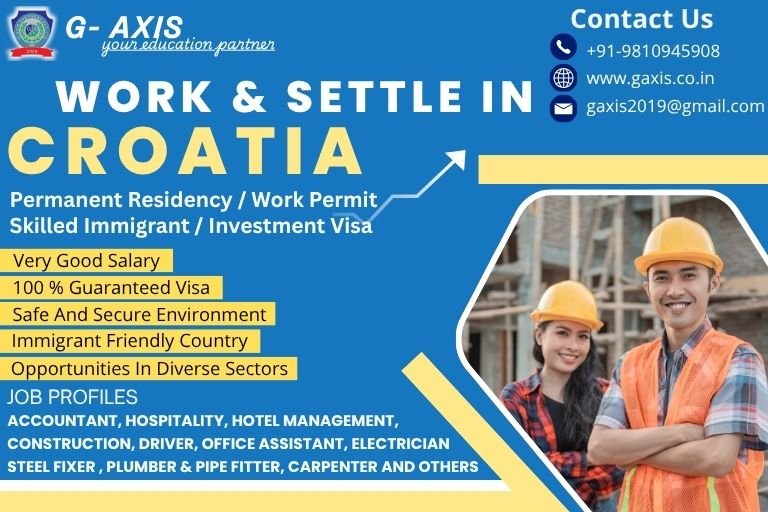
Croatia is a stunning, crescent-shaped country in Southeastern Europe, located along the Adriatic Sea. It is famous for its crystal-clear coastline, over 1,000 islands, and historic cities like Dubrovnik. It is iconic for its breathtaking, UNESCO-listed Plitvice Lakes National Park, Roman ruins such as Diocletian’s Palace, and as the birthplace of the necktie. Croatia is a good, emerging destination for working and settling, offering a high quality of life, safety, and a growing demand for foreign labor in sectors like construction, tourism, and IT. With eased visa policies, it serves as a gateway to the EU, allowing for permanent residency after 5 years. Croatia is considered a very safe, stable, and welcoming country for tourists, consistently ranking among the top 20 safest nations in the world.
1. Official name: Republic of Croatia
2. Location: Southeastern Europe, situated at the crossroads of Central and Southeast Europe on the Adriatic Sea.
3. Area: Approximately 56,594 square kilometres (21,851 sq miles).
4. Capital: Zagreb
5. Currency: Euro (€)
6. Languages: Croatian
7. Economy: A high-income, service-based economy where tourism is a major driver, accounting for nearly 20% of GDP. Other key sectors include food processing, pharmaceuticals, and shipbuilding.
8. Total population: Estimated at approximately 3.82 million as of early 2026.
1. Continuous Stay: Generally 5 years of legal temporary residence, with no more than 10 months total absence (or 6 months at once) during that period.
2. Documentation: Valid passport, proof of sufficient funds/means of subsistence, and health insurance.
3. Language: Basic knowledge of the Croatian language and Latin script is required.
4. Background: Must not be a threat to public order or national security.
Special Pathways & Exceptions
1. Emigrants/Descendants: Individuals with a Certificate of Croatian Emigration may apply for permanent residence after only 3 years of temporary residence.
2. Spouses/Family: Spouses of Croatian citizens or those with permanent residency can sometimes apply sooner.
3. Refugees: Those with granted asylum or subsidiary protection may have different timelines.
| Temporary residence permit types | – employment, – family reunification, – study, – training, – medical treatments |
Time needed to obtain the temporary residence permit (approx.) | Around 3 months |
Temporary residence permit validity | 1 year |
| Documents for obtaining temporary residence | – valid passport, – work contract, – criminal record, – accommodation |
| Mandatory registrations with state authorities (i.e. with the population/municipality register) | Yes |
| Dependents can join the temporary permit holder | Yes |
| Temporary or permanent residency for investment purposes | Yes |
| Minimum temporary residence before applying for permanent residence | 5 years |
| Documents for obtaining permanent residence | – valid passport, – proof of income, – former temporary residence permit |
| Naturalization requirements | – Croatian language and culture knowledge, – permanent resident for at least 8 years |
| Citizenship after permanent residence | Yes |
There are two primary types of permanent residence for third-country nationals in Croatia, both granting indefinite stay:
1. Dugotrajno boravište (Long-term residence): Generally granted to third-country nationals after 5 years of continuous, legal temporary residence in Croatia.
2. Stalni boravak (Permanent residence/stay): Granted under more favorable terms, often in less than 5 years, for specific categories, including:
1. Eligibility: Generally requires 5 years of continuous legal temporary residence (e.g., work, study, family reunification).
2. Requirements: You must have a valid passport, sufficient funds, health insurance, and show a “real intention to settle”.
3. Absences: Continuous residence means not being absent for more than 10 months total or 6 consecutive months over the 5-year period.
4. Application: Submitted to the local police department (MUP).
Path to Citizenship by Naturalization
1. Residency Requirement: 8 years of continuous, legal, and registered residence.
2. Status Requirement: You must hold a permanent residence permit (granted after the initial 5 years).
3. Language & Culture: Applicants must pass a proficiency test in the Croatian language and Latin script, demonstrating knowledge of Croatian culture and social system.
4. Requirements: Clean criminal record (not just in Croatia but also in your home country), proof of financial means, and no security risks.
5. Dual Citizenship: Croatia allows dual citizenship, though you may be required to formally renounce your previous citizenship depending on your situation.
1. Time Limit: You cannot have been outside Croatia for more than 10 months total (or 6 consecutive months) during the 5-year period.
2. Documentation: Prepare a valid passport, proof of funds, health insurance, and proof of accommodation (e.g., lease agreement).
3. Language & Culture Test: You must pass a basic Croatian language and Latin script exam, which can be done through institutions like Croaticum.
4. Application Timing: Apply on the day your temporary permit expires. It is crucial not to apply early or late.
5. Alternative Paths: If married to a Croatian citizen, you may apply after three years of continuous, lawful residency.
1. Stunning Coastline & Beaches: Over 1,800 km of coastline with crystal-clear Adriatic water and hidden bays.
2. Affordable Cost of Living: Lower expenses than many Western European countries, allowing for a better quality of life.
3. High Safety Levels: A very safe country where you can walk alone at night without fear.
4. Mediterranean Climate: Enjoy4 distinct seasons with mild winters and hot summers.
5. Relaxed Lifestyle: A focus on family, leisure, and enjoying the present moment.
6. EU & Schengen Access: Free movement and easy travel across 29 European countries.
7. Rich History & Culture: Thousands of years of history, including Roman ruins and UNESCO sites like Diocletian’s Palace.
8. Incredible Food & Wine: Fresh seafood, Mediterranean produce, and excellent local wines.
9. Stunning Nature: Eight national parks, including the famous Plitvice Lakes.
10. English is Widely Spoken: Easy communication with locals and expats, especially in tourist areas and cities.
Working in Croatia is increasingly popular, offering a good work-life balance, a safe environment, and a growing job market, particularly in tourism, construction, and logistics. As a Schengen area country with a lower cost of living than Western Europe, it offers a solid, affordable lifestyle.
Key Aspects of Working in Croatia:
1. Job Market: High demand for labor, especially in hospitality and construction.
2. Cost of Living: Generally lower compared to Western Europe.
3. Work-Life Balance: Strong emphasis on 40-hour work weeks, with paid annual leave (minimum 4 weeks).
4. Visa/Legal: Eased policies for foreign workers, including access to the Schengen area.
5. Work Culture: Often hierarchical, with English commonly spoken in tourism, though basic Croatian helps.
6. Salary: Competitive for the region, allowing for a comfortable life.
1.Waiters (High seasonal demand)
2. Cooks/Chefs (Year-round and seasonal)
3. Cleaners/Housekeeping
4. Kitchen Assistants/Helpers
5. Hotel Receptionists
6. Bartenders
7. Tour Guides
8. Tourism/Hospitality Directors
9. Bricklayers/Masons
10. Carpenters
11. Electricians
12. Plumbers/Pipe Fitters
13. Welders
14. Construction Labourers
15. Crane Operators/Machinery Operators
16. Painters/Decorators
17. Roofers
18. Civil Engineers
19. Software Developers
20. IT Support Specialists
21. UI/UX Designers
22. Data Analysts/Scientists
23. Cybersecurity Experts
24. Heavy Truck/Lorry Drivers
25. Warehouse Workers/Packers
26. Machine Operators
27. Fitters/Mechanical Technicians
28. Nurses/Registered Nurses
29. Caregivers/Personal Care Workers
30. Pharmacists
1. Average Salary: Approximately €1,340–€1,446 net per month.
2. Minimum Wage: €1,050 gross per month (effective Jan 1, 2026).
3. Highest Paying Fields: Air traffic controllers (€7,000+), CEOs, anesthesiologists, and IT professionals (€1,800–€3,000+).
4. Sector Variations: Tourism/Hospitality average around €1,287, while textile industries can be lower.
A Croatia work and residence permit (“single permit”) allows non-EU/EEA nationals to live and work for a specific employer, typically valid for 1-2 years and extendable. Applications are usually initiated by the employer through the local police station, requiring a labor market test and a signed contract.
Key permits include the Standard Work Permit, EU Blue Card for high-skilled workers, and Seasonal permits.
1. Permit Types: The most common is the Single Residence and Work Permit, which combines residency and work authorization. Highly qualified workers may qualify for an EU Blue Card (valid for up to 2 years).
2. Application Process: Employers generally must apply for a labor market test via the Croatian Employment Service to prove no suitable local candidate exists.
3. Duration & Extension: Standard permits are usually valid for up to 1 year, extendable at least 30-60 days before expiration.
4. Requirements: A valid employment contract, passport copy, proof of qualification, and health insurance are required.
5. Validity: Permits are tied to a specific employer and position.
1. Stay and Work Permit (Single Permit): The main permit for foreign nationals with a job offer from a Croatian company.
2. EU Blue Card: A special type of stay and work permit for highly qualified individuals with higher education and a long-term contract, valid for up to 2 years.
3. Self-Employment Permit: For entrepreneurs, freelancers, or professionals establishing their own business in Croatia.
4. Digital Nomad Visa: A temporary stay permit (up to 12 months) for remote workers employed by a company outside Croatia.
5. Seasonal Worker Permit: For short-term work (up to 6 or 9 months) in sectors like tourism and agriculture.
6. Intra-Company Transfer Permit: For employees transferred from a foreign company to a Croatian branch.
1. Job Offer/Contract: A signed employment contract or letter of intent specifying the job role and salary.
2. Valid Passport: A passport valid for at least three months beyond the intended stay.
3. Police Clearance Certificate: A legalized certificate proving a clean criminal record.
4. Qualifications: Proof of education, diplomas, or certificates relevant to the job.
5. Health Insurance: Proof of travel or private health insurance valid in Croatia.
6. Photographs: Recent passport-sized photos, typically 2 (5 cm x 5 cm) with a white background.
7. Financial Means: Proof of sufficient funds to support the stay, such as bank statements.
1. Application Form: Fully completed in English or Croatian and signed by the applicant.
2. Passport: Valid for at least 3 months after the visa expiry, issued within the last 10 years, with at least two empty pages.
3. Photographs: Two recent color passport-size photos (35x45mm) with white background.
4. Work Permit/Job Offer: Letter/permit issued by a Croatian employer (not older than 60 days).
5. Proof of Purpose: Documents showing the nature of work, such as an employment contract.
6. Police Clearance Certificate (PCC): Valid, original, and legalized/apostilled (specifically for applicants from India).
7. Accommodation Proof: Evidence of secured accommodation in Croatia (e.g., lease agreement, hotel reservation).
8. Travel Health Insurance: Valid for Croatia, covering at least 30 days or the duration of travel, with minimum €30,000 coverage.
9. Means of Transportation: One-way flight/travel booking.
10. Proof of Sufficient Funds: Bank statements or pay slips from the last three months to prove financial capability.
11. Passport Photocopy: Clear copies of the front/last page and all used pages.
Lifestyle in Croatia is generally considered excellent, offering a high quality of life with a relaxed, Mediterranean pace known as “pomalo” (taking it easy). It is safe, boasting low crime rates, and features a stunning, diverse environment with clear Adriatic waters and mountainous landscapes.
1. Cost of Living: It is relatively affordable compared to Western European countries, particularly for those with remote income, savings, or pensions. Monthly costs for a comfortable lifestyle can range from $1,500 to $3,000, depending on location.
2. Safety & Security: Known as a very safe country, allowing for a secure environment for families and individuals, even late at night.
3. Culture & Environment: A strong café culture exists, prioritizing social time and relaxation. The country boasts incredible natural beauty, including 8 national parks, numerous islands, and clean beaches.
4. Infrastructure & Services: Good infrastructure, including high-quality, fenced highways. The healthcare system is generally considered strong.
5. Challenges: Local salaries can be low, and the bureaucracy can be slow or complex, which is a common complaint.
can help – fill in your details and we’ll call you back.
Chat Now