Switzerland is a landlocked, politically neutral country in Central Europe, renowned for its stunning Alpine scenery, high quality of life, and banking sector. Switzerland is consistently ranked as one of the safest and most secure countries in the world, with very low violent crime rates. It is a federal republic comprising 26 cantons, with Bern as its capital, and features four official languages German, French, Italian, and Romansh.
Switzerland is iconic for its breathtaking Alpine scenery—including the Matterhorn and Jungfrau—world-renowned chocolates, luxury watchmaking, and precision engineering. It is also famous for high-quality cheese, efficient scenic railways, neutral diplomacy, and a high standard of living.
1. Official name: Swiss Confederation
2. Location: A landlocked country in Central Europe. It is bordered by Germany to the north, France to the west, Italy to the south, and Austria and Liechtenstein to the east
3. Area: Approximately 41,285 to 41,291 square kilometres.
4. Capital: Bern
5. Currency: Swiss franc (CHF).
6. Languages: There are four official languages: German, French, Italian, and Romansh.
7. Economy: One of the world’s most advanced and stable economies, with a major focus on banking, financial services, pharmaceuticals, watchmaking, and tourism. Its nominal GDP is estimated at approximately $1.06 trillion for 2025.
8. Total Population: Estimated at approximately 9.24 million as of March 2026.
Settling in Switzerland offers an exceptionally high quality of life, characterized by top-tier safety, world-class healthcare, and a strong, stable economy. It is ideal for families seeking a peaceful environment with excellent education and outdoor activities.
Here are the top reasons to settle in Switzerland:
1. Highest Quality of Life: Switzerland frequently ranks as the top country globally for quality of life, offering a safe, clean, and stable environment.
2. Exceptional Salaries and Purchasing Power: Residents enjoy some of the highest salaries in the world, often exceeding $65,000 annually, enabling significant wealth accumulation.
3. Safety and Low Crime: It is an incredibly safe country where children can walk to school independently, fostering a high level of trust.
4. Stunning Natural Beauty: The country features dramatic landscapes, including the Alps and, pristine lakes, providing endless outdoor, activities like hiking and skiing.
5. Strong Work-Life Balance: A, culture that respects personal time ensures, that work does not consume life.
Permanently moving to Switzerland involves obtaining a C Permit (Permanent Residence), which allows non-Swiss nationals to live and work indefinitely with the same rights as citizens, excluding voting. Typically, this requires 10 years of continuous, legal residency (5 years for EU/EFTA citizens), along with financial stability, language proficiency, and a clean criminal record.
Switzerland immigration for EU/EFTA citizens is governed by the Agreement on the Free Movement of Persons (AFMP), granting citizens from these nations the right to live and work in Switzerland. While no visa is required for entry, a residence permit is necessary for stays longer than three months or for employment.
Non-EU/EFTA citizens (third-country nationals) face strict immigration quotas to live and work in Switzerland, requiring a confirmed job offer, specialized skills, and proof that no local or EU/EFTA candidate could fill the position.
1. Residency: At least 10 years of legal residence in Switzerland, with the last 3 years preceding application occurring within the last 5 years. Years spent in Switzerland between ages 8 and 18 count double.
2. Permit Type: A C permit (permanent residence) is generally required.
3. Language Skills: Proficient in German, French, Italian, or Romansh (spoken: B1, written: A2).
4. Integration: Successful integration into local life, including knowledge of geography, history, and politics.
5. Financial Security: Proof of financial stability, including no reliance on social welfare (often required for the 3 years preceding application).
6. No Criminal Record: A clean criminal record is essential.
1. Identification: A valid passport and, if applicable, previous passports to document residency history.
2. Residence Permit: Proof of holding a valid residence permit (typically a C permit, obtained after 10 years of legal residence or 5 years under certain conditions).
3. Language Proficiency: Certificates demonstrating B1 spoken and A2 written proficiency in a national language (German, French, or Italian).
4. Financial Stability: Recent tax returns, salary slips, and proof of employment.
5. Proof of Integration: Documents showing active participation in community life, such as membership in clubs, volunteering, or references.
6. Background Check: A recent criminal record certificate (often from both your home country and Switzerland).
7. Medical Certificate: A certificate, typically dated within the last three months.
8. Forms: A completed application form from the Cantonal Naturalization Office
Yes, Switzerland allows dual citizenship without restriction, a policy in place since January 1, 1992. Swiss citizens can acquire foreign citizenship without losing their Swiss nationality, and foreign nationals do not need to renounce their original citizenship when becoming Swiss. However, the other country involved must also permit dual citizenship.
Working in Switzerland is generally considered excellent, offering some of the highest salaries in the world, low taxes, and a high quality of life. It features a stable,, high-performing economy with top-tier healthcare and safety. However, the cost of living is extremely high, and the job market is competitive, often requiring specialized skills.
1. Software Engineer
2. Data Scientist
3. Nursing Professional
4. Mechanical Engineer
5. Financial Analyst
6. Cybersecurity Specialist
7. Biotechnology Researcher
8. Civil Engineer
9. Pharmaceutical Professional
10. Automation Engineer
11. Wealth Manager
12. Electrical Engineer
13. Supply Chain Manager
14. Medical Specialist/Doctor
15. IT Consultant
16. Process Engineer
17. Marketing Manager
18. Compliance Manager
19. Human Resources Manager
20. Project Manager
The Swiss job market in 2026 is robust, characterized by high salaries, very low unemployment (2–3%), and a high demand for specialized, skilled foreign talent, particularly in IT, engineering, healthcare, and finance. While it offers excellent work-life balance and high living standards, securing employment is competitive and often requires specific, highly specialized skills.
1. Average Annual Salary: Roughly CHF 80,000 to over CHF 100,000 per year, depending on experience and industry.
2. Monthly Salary: Often around CHF 6,000–8,000 per month gross, with a net of roughly CHF 5,430 after deductions.
3. High-Demand Sectors:
1. Labor laws and labor rights in Switzerland
2. Working Hours: Maximum weekly hours are 45 for industrial/office staff and 50 for others. Overtime is compensated at 125% of the regular wage or through time off.
3. Rest Periods: Employees are entitled to at least 11 hours of rest between shifts and at least one day off per week (usually Sunday).
4. Termination: Notice periods are often defined by contract or statute, with restrictions on firing during sickness, pregnancy, or military service.
5. Leave: Minimum statutory vacation is 4 weeks (5 weeks for employees under 20). Maternity leave is 14 weeks, while paternity leave is two weeks.
6. Minimum Wage: While not federal, several cantons have established minimum wages (e.g., Geneva, Basel-Stadt, Jura, Ticino).
7. Social Security: Mandatory contributions for unemployment, pension (pillar 1 and 2), and disability are shared between employer and employee.
8. Foreign Workers: Citizens from EU/EFTA countries benefit from easier access, but quotas exist for non-EU/EFTA nationals.
Lifestyle in Switzerland is characterized by an exceptionally high quality of life, emphasizing precision, outdoor activity, and work-life balance, all set against a backdrop of stunning natural beauty. Residents enjoy high salaries,, top-tier infrastructure, and safety, though this comes with a very high cost of living, strict social rules, and, in some cases, challenging,, integration for expats.
1. Work-Life Balance: While work is valued (approx. 40-42 hours per week), time off is respected, with at least four weeks of paid holiday
2. Outdoor Culture: Daily life often revolves around nature, with hiking, skiing, and visiting lakes being popular
3. Cost of Living: High, with expensive,, housing, healthcare, and groceries.
4. Language: The country has four official languages (German, French, Italian, and Romansh), with English widely spoken in cities like Zurich.
5. Social Life: Making friends can take time, as residents value privacy.
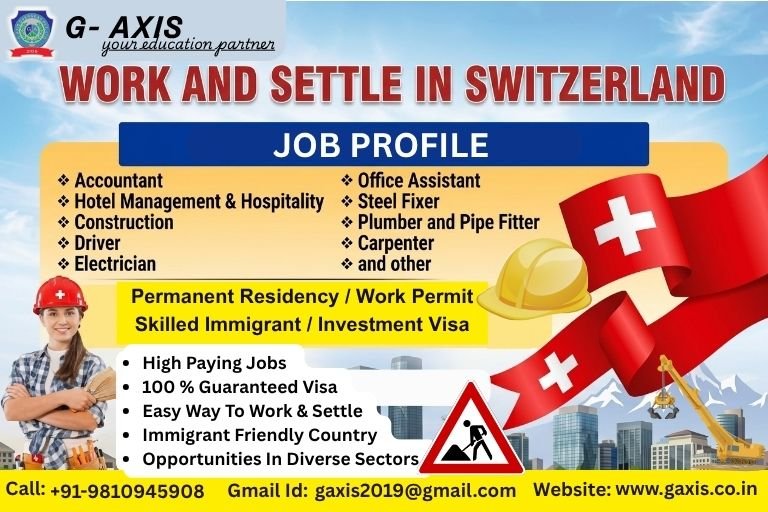
G-Axis offers reliable visa services for all countries. Our team of experienced Visa experts will guide you through the process step-by-step, from verifying your documents to the submission of your visa documents to the Swiss Embassy. We also have a dedicated call center to answer all your queries regarding your Switzerland work visa application.
can help – fill in your details and we’ll call you back.
Chat Now